Oil is the backbone of the modern economy. From transportation and electricity generation to industries and defense operations, almost every sector depends on petroleum products. But what happens if global oil supplies suddenly stop due to war, geopolitical tensions, or natural disasters?
This is where the Strategic Petroleum Reserve (SPR) becomes extremely important.
India, one of the world’s largest oil-consuming countries, has built its own Strategic Petroleum Reserve to protect the nation during emergencies and supply disruptions. In recent years, the topic has gained attention because of global conflicts, crude oil price volatility, and growing energy security concerns.
What Is a Strategic Petroleum Reserve?
A Strategic Petroleum Reserve (SPR) is a large stockpile of crude oil stored by a government for emergency use during supply disruptions, economic crises, or geopolitical conflicts.
These reserves act like an emergency backup system. If oil imports are disrupted or international prices rise sharply, the government can release oil from these reserves to stabilize supply and reduce panic.
In simple words, the Strategic Petroleum Reserve is India’s “oil emergency fund.”
Why India Needs a Strategic Petroleum Reserve
India imports around 85% of its crude oil requirements from other countries. This heavy dependence on imports makes the country vulnerable to:
- Global oil price shocks
- Wars and geopolitical tensions
- Supply chain disruptions
- Shipping route blockages
- OPEC production cuts
If oil imports stop even for a short period, transportation, industries, and electricity generation could face serious disruption.
Therefore, maintaining emergency oil reserves is essential for India’s energy security.
History of Strategic Petroleum Reserve in India
The idea of building petroleum reserves gained importance after major global oil crises. One of the biggest turning points was the 1990 Gulf War, which exposed the risks of depending heavily on imported crude oil.
Later, rising global tensions and fluctuating crude prices pushed India to formally establish a Strategic Petroleum Reserve system.
The Indian government approved the project in phases to ensure long-term energy security.
Who Manages India’s Strategic Petroleum Reserve?
India’s Strategic Petroleum Reserve is managed by Indian Strategic Petroleum Reserves Limited, a subsidiary under the Ministry of Petroleum and Natural Gas.
Its main responsibility is:
- Building underground storage facilities
- Managing crude oil reserves
- Coordinating emergency oil release if needed
Current Strategic Petroleum Reserve (SPR) Infrastructure in India
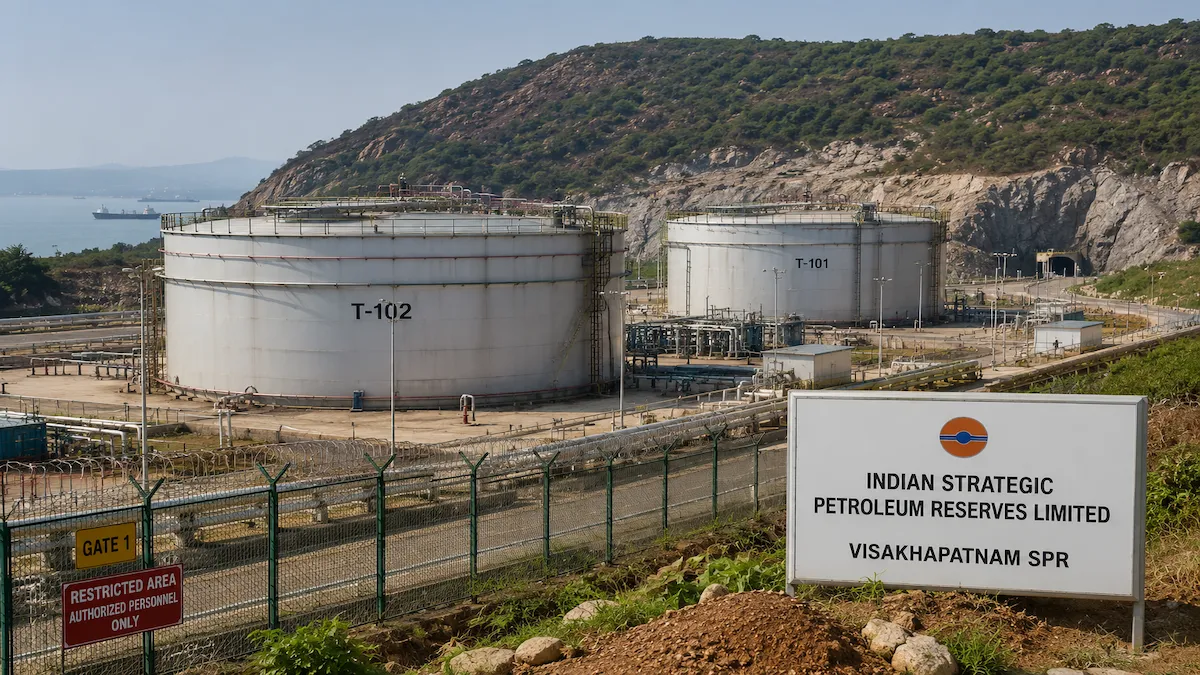
India currently operates three major Strategic Petroleum Reserve (SPR) facilities designed to strengthen the country’s energy security during emergencies or global supply disruptions. These underground crude oil storage sites are located at Visakhapatnam in Andhra Pradesh, and Mangaluru and Padur in Karnataka. All three facilities are strategically positioned near coastal regions to ensure easier access for crude oil transportation and storage operations.
At present, India’s combined SPR storage capacity stands at approximately 5.33 million metric tonnes (MMT), which is equivalent to nearly 39 million barrels of crude oil. This reserve is capable of meeting around 9.5 days of India’s total crude oil requirement, considering the country consumes nearly 5.5 million barrels of oil per day.
These emergency reserves are different from the regular commercial fuel stocks maintained by public sector oil companies such as Indian Oil Corporation Limited (IOCL), Hindustan Petroleum Corporation Limited (HPCL), and Bharat Petroleum Corporation Limited (BPCL). While commercial inventories are used for day-to-day operations and fuel supply, SPR reserves are meant specifically for national emergencies, geopolitical crises, or severe disruptions in global oil supply chains.
India’s Future Plans to Expand Strategic Petroleum Reserves
India is now focusing aggressively on expanding its Strategic Petroleum Reserve capacity due to rising geopolitical tensions, increasing energy demand, and heavy dependence on imported crude oil. The government’s long-term goal is to build a much stronger emergency energy backup system capable of protecting the economy during major global crises.
As part of the next phase of expansion, new SPR projects are being planned at multiple locations across the country. One of the largest upcoming projects is the Chandikhol SPR facility in Odisha, which is expected to have a storage capacity of around 4 MMT and will be developed in phases. Another major expansion project is Padur Phase II in Karnataka, which is planned with an additional 2.5 MMT capacity.
Apart from these, India is also evaluating nearly six additional SPR locations, including projects in the Mangalore Special Economic Zone (SEZ) in Karnataka and proposed underground salt cavern storage facilities in Bikaner, Rajasthan. Salt caverns are considered highly efficient for crude oil storage because of their natural sealing properties and lower maintenance requirements.
Once these projects are completed, India’s total SPR storage capacity is expected to increase to nearly 11.83 MMT, which would be sufficient to meet approximately 22 days of national crude oil demand.
In the long run, India aims to gradually build oil reserves capable of covering up to 90 days of consumption, aligning itself with the energy security standards recommended by the International Energy Agency (IEA). This expansion strategy reflects India’s broader vision of reducing vulnerability to global oil market shocks and strengthening national energy resilience.
Current Strategic Petroleum Reserve (SPR) Sites in India
| SPR Location | State | Status | Approx. Capacity |
|---|---|---|---|
| Visakhapatnam | Andhra Pradesh | Operational | 1.33 MMT |
| Mangaluru | Karnataka | Operational | 1.50 MMT |
| Padur | Karnataka | Operational | 2.50 MMT |
Total Current SPR Capacity: 5.33 MMT (around 39 million barrels)
Upcoming & Proposed Strategic Petroleum Reserve Sites in India
| Future SPR Location | State | Project Status | Planned Capacity |
|---|---|---|---|
| Chandikhol | Odisha | Planned (Phase-wise) | 4.00 MMT |
| Padur Phase II | Karnataka | Expansion Project | 2.50 MMT |
| Mangalore SEZ | Karnataka | Proposed | Under Planning |
| Bikaner Salt Caverns | Rajasthan | Proposed | Under Evaluation |
Why Underground Storage Is Used
Underground rock caverns offer several advantages:
- Better protection during war or attacks
- Stable temperature conditions
- Reduced evaporation and fire risk
- Long-term secure storage
This makes them ideal for strategic energy reserves.
How Does the Strategic Petroleum Reserve Work?
The functioning of SPR is relatively simple but highly important.
Step 1: Crude Oil Is Purchased
The government buys crude oil from global markets, often when prices are favorable.
Step 2: Oil Is Stored
The crude oil is stored in underground caverns.
Step 3: Emergency Situation Occurs
If global supplies are disrupted or prices spike sharply, the government can release crude oil into the domestic market.
Step 4: Stabilization
The released oil helps maintain fuel supply and reduce economic pressure.
How Much Oil Can India Store?
India’s Strategic Petroleum Reserve can currently store crude oil sufficient for several days of national consumption. Combined with reserves held by oil companies, India maintains emergency stock for a longer duration.
However, compared to countries like the United States, India’s reserves are still relatively smaller, which is why expansion plans are ongoing.
Strategic Petroleum Reserve vs Commercial Oil Storage
Many people confuse SPR with normal oil storage.
Strategic Petroleum Reserve
- Owned by government
- Used only during emergencies
- Focused on national security
Commercial Oil Storage
- Used by oil companies for daily business
- Regularly bought and sold
- Not meant for emergencies
Why SPR Became More Important After Global Crises
Several recent global events highlighted the importance of strategic oil reserves.
1. Russia-Ukraine Conflict
Global crude prices became highly volatile due to sanctions and supply concerns.
2. COVID-19 Pandemic
Energy markets experienced unprecedented disruptions.
3. Middle East Tensions
Oil shipping routes faced security concerns.
These events showed how quickly fuel prices and supplies can be affected globally.
Benefits of Strategic Petroleum Reserve
1. Energy Security
Ensures fuel availability during emergencies.
2. Economic Stability
Helps reduce sudden fuel price shocks.
3. National Security
Essential during war or geopolitical crises.
4. Market Confidence
Prevents panic buying and supply fears.
5. Strategic Advantage
Strengthens India’s position in global energy markets.
Challenges Faced by India’s SPR System
Despite its importance, India’s petroleum reserve system also faces some challenges.
1. High Construction Cost
Building underground caverns is expensive.
2. Large Import Dependence
India still relies heavily on foreign crude oil.
3. Limited Current Capacity
Existing reserves cover only a limited duration compared to major economies.
4. Price Volatility
Purchasing oil at the wrong time can increase costs.
India’s Future Expansion Plans
India plans to expand its Strategic Petroleum Reserve capacity significantly in the coming years.
Future goals include:
- Building new storage facilities
- Increasing emergency reserve duration
- Encouraging public-private partnerships
- Enhancing energy resilience
As energy demand rises, India’s need for larger reserves will also increase.
How Other Countries Use Strategic Petroleum Reserves
Many major countries maintain SPR systems.
United States
The U.S. has one of the world’s largest petroleum reserves.
China
China is rapidly expanding its oil reserves.
Japan & South Korea
Both maintain strong emergency oil stockpiles.
India is following a similar long-term energy security strategy.
Strategic Petroleum Reserve and Fuel Prices
One common question is whether SPR can reduce petrol and diesel prices.
The answer is partially yes.
If crude oil prices rise sharply due to global events, releasing oil from reserves can help stabilize supply and reduce extreme price pressure. However, fuel prices also depend on taxes, refining costs, and international markets.
Why Strategic Petroleum Reserve Matters for Common Citizens
Most people may never directly see the impact of SPR, but it plays a major role in daily life.
Without emergency reserves:
- Fuel shortages could occur
- Transportation costs may rise sharply
- Inflation could increase
- Essential supplies could be disrupted
Therefore, SPR indirectly protects economic stability for ordinary citizens.
Also Read: Fuel Price Increase in India Explained: 7 Key Reasons Behind Rising Petrol and Diesel Costs
Strategic Petroleum Reserve and National Security
Energy security is now considered part of national security. During conflicts or emergencies, uninterrupted fuel supply is critical for:
- Military operations
- Transportation networks
- Power generation
- Healthcare systems
This is why countries invest heavily in strategic reserves.
India’s Strategic Petroleum Reserve is one of the country’s most important energy security assets. In a world where geopolitical tensions, wars, and oil market instability are becoming more common, maintaining emergency crude oil reserves is essential.
Although India’s SPR capacity is still growing, it represents a crucial step toward protecting the economy, ensuring fuel availability, and strengthening national security.
As India’s energy demand continues to rise, the Strategic Petroleum Reserve will become even more important in the years ahead.
For more information about India’s energy initiatives, visit the official website of the Ministry of Petroleum and Natural Gas
For more latest updates on Trending News, Entertainment, Automobile, Education, Technology, Jobs, weather and sports visit IndicDaily.
Frequently Asked Questions (FAQs)
-
What is Strategic Petroleum Reserve in simple words?
It is an emergency stockpile of crude oil maintained by the government for use during supply disruptions or crises.
-
Why does India need a Strategic Petroleum Reserve?
India imports most of its crude oil, making it vulnerable to global supply disruptions and price shocks.
-
Who manages India’s Strategic Petroleum Reserve?
It is managed by Indian Strategic Petroleum Reserves Limited.
-
Where are India’s petroleum reserves located?
Major reserve sites are located in Visakhapatnam, Mangaluru, and Padur.
For more latest updates on Trending News, Entertainment, Automobile, Education, Technology, Jobs, weather and sports visit IndicDaily.