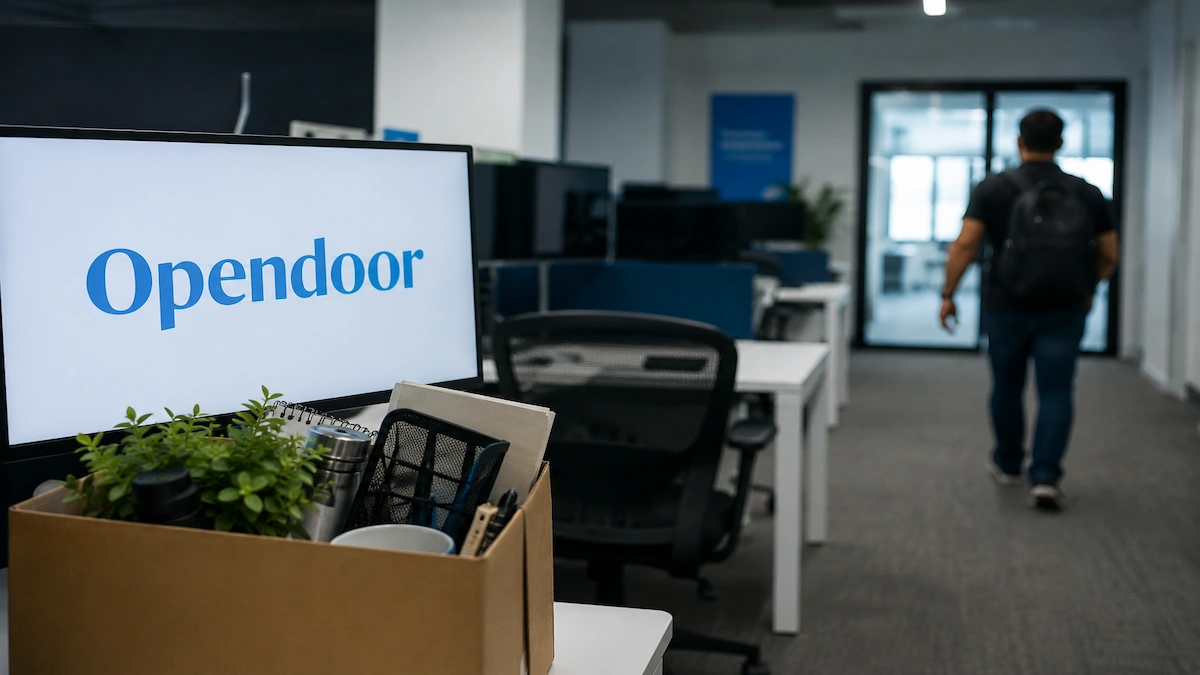
The global technology outsourcing landscape is facing a major structural shift. In a sudden corporate realignment, US-based digital real estate pioneer Opendoor Technologies officially announced the complete closure of its India operations.
The strategic shutdown immediately impacts approximately 250 local employees across the company’s hubs in Bengaluru and Chennai.
The decision, made public by Opendoor CEO Kaz Nejatian via an internal memo shared on social media platform X, has triggered a massive debate across Silicon Valley and Indian technology corridors. It highlights how the rapid rise of enterprise-grade artificial intelligence (AI) is beginning to challenge traditional offshore back-office models.
The Strategic Shutdown: What is “Opendoor 2.0”?
The sudden exit of the San Francisco-headquartered iBuying giant comes less than two years after it established an institutional footprint in India. The company had initially built up its Indian workforce to handle manual data entries, fragmented software workarounds, and backend verification tracking for the highly complex American residential property market.
However, the launch of “Opendoor 2.0” marked a major shift in corporate operations. According to leadership, the company spent the last several months consolidating its disparate legacy tech tools, optimizing automated pipelines, and deploying highly specialized, AI-native customer-facing teams entirely within the United States.
In his public statement, CEO Kaz Nejatian outlined the company’s geographic rationale:
“Today we began to say goodbye to our colleagues in India as we wind down our India operations. Our customers are in America, and that’s where our operational work belongs.”
The company confirmed that while a tiny transition squad will remain temporarily to oversee the secure handover of data assets, the physical offices in India will close completely.
Key Timelines and Impact Metrics
| Metric Component | Details & Figures |
| Total Impacted Headcount | Approximately 250 Employees |
| Primary Indian Office Hubs | Bengaluru and Chennai |
| Parent Company Global Headcount | 1,042 (At the close of the last fiscal year) |
| Stock Market Response | OPEN shares surged 8% immediately post-announcement |
| Offered Employee Support | Severance packages, transition healthcare, outplacement assistance |
Performance vs. Automation: Why India Lost the Roles
Opendoor’s leadership explicitly stated that the mass layoffs are not a reflection of poor employee performance or low-quality work by the Indian engineering and operations teams. Nejatian praised the local staff as “excellent people” and actively recommended them to other corporate recruiters.
Instead, the shutdown serves as a textbook case of AI replacing manual process layers.
For years, the international tech industry relied on cost-arbitrage—hiring large offshore teams in talent-dense nations like India to manually bridge gaps between fragmented software architectures. With Opendoor unifying these back-end architectures through AI-native automation, the structural need for large offshore processing teams has fundamentally dropped.
By shifting tasks to compact, AI-assisted operational groups located directly in the United States, Opendoor expects to scale down its global corporate headcount while expanding individual job scopes.
Market Implications: Is the Offshore Outsourcing Model at Risk?
The tech industry is watching Opendoor’s exit closely. India is currently the absolute global leader for Global Capability Centers (GCCs), hosting over 2,100 centers that employ roughly 2.36 million professionals and generate close to $100 billion in annual economic value.
While macroeconomic pressures in the US housing market definitely influenced Opendoor’s cost-cutting, venture capitalists and outsourcing analysts view this specific strategy as an early warning sign. As AI tools advance at an exponential rate, companies can increasingly bypass manual workflows entirely, allowing them to bring operations closer to home without paying massive domestic overhead costs.
Following the announcement on Wall Street, OPEN stock gained 8%, signaling strong investor support for lean, automated, and centralized business structures.
Support and Compensation for Displaced Workers
To soften the blow of the sudden closure, Opendoor is rolling out structured transition packages for all affected Indian professionals. The support ecosystem includes:
- Financial severance payouts mapped to tenure.
- Outplacement placement services to connect engineers with local Indian GCCs.
- Transitional health coverage benefits.
As automation continues to rewrite corporate strategies, Opendoor’s rapid exit highlights a new reality for tech workers: the future of operations relies less on the size of the team and more on the depth of its integration with AI.
Stay Informed. Stay Connected.
Don’t stop here! There is always more to discover. Head back to our main feed at IndicDaily.com to catch up on the latest trends, deep-dives, and actionable guides across finance, technology, sports, and careers.
Also Read: Vangelia Pandeva Dimitrova: The Enigmatic Prophet Who Fascinated the World