The global discourse surrounding gender equality has evolved from advocating basic civil rights to demanding equal partnership in governance. In India, this evolution reached a historic milestone with the passage of the Women’s Reservation Bill, officially designated as the Nari Shakti Vandan Adhiniyam (The Constitution One Hundred and Sixth Amendment Act).
The legislation promises to fundamentally alter India’s democratic framework by reserving 33% (one-third) of all seats in the Lok Sabha (the Lower House of Parliament) and State Legislative Assemblies for women. While lauded as a paradigm shift toward inclusive democracy, the bill remains the subject of intense national debate.
As India positions itself as a dominant global economic and geopolitical power, evaluating how it structures its internal democracy is critical. Does the Nari Shakti Vandan Adhiniyam guarantee genuine systemic empowerment, or is it merely the framework for a much longer, complex socio-political reform process?
1. What is the Women’s Reservation Bill (Nari Shakti Vandan Adhiniyam)?
The primary objective of the Nari Shakti Vandan Adhiniyam is to address the structural underrepresentation of women in India’s highest legislative bodies. Passed during a special session of Parliament, the bill introduces constitutional amendments to systematically integrate women into lawmaking.
Key Constitutional Mechanisms
The legislation modifies India’s constitutional framework through several targeted insertions:
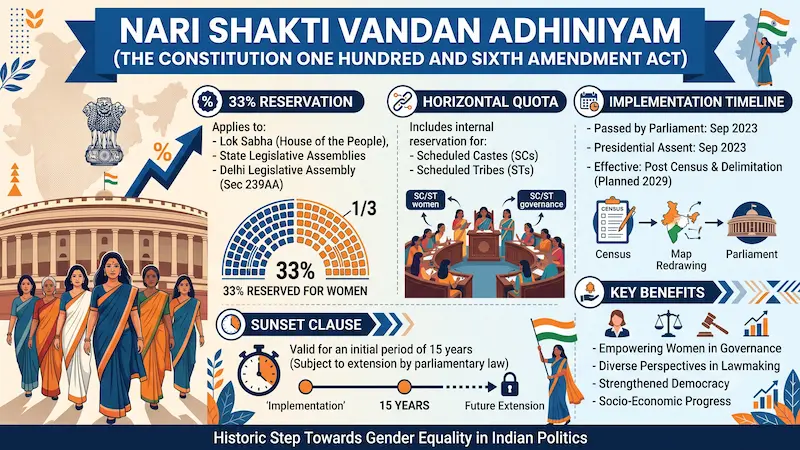
- Article 330A: Establishes the reservation of seats for women in the Lok Sabha. It mandates that one-third of the total seats allocated to Scheduled Castes (SCs) and Scheduled Tribes (STs) must be reserved for women from those respective communities, alongside a general one-third quota for all other seats.
- Article 332A: Mirrors this mandate across all State Legislative Assemblies, ensuring that regional governance bodies reflect the same baseline of female representation.
- Article 334A (The Sunset Clause): Dictates that the reservation policy will remain in effect for an initial duration of 15 years from the date of its operational commencement. Parliament retains the legal authority to extend this period through subsequent legislation.
2. Historical Context: The Three-Decade Legislative Journey
The passage of the Nari Shakti Vandan Adhiniyam that is was not a sudden legislative occurrence; it concluded an erratic, thirty-year political struggle. Understanding this history highlights the deep-seated political resistance and shifting priorities that shaped the current policy.
The Panchayati Raj Foundation (1992-1993)
The 73rd and 74th Constitutional Amendment Acts under Prime Minister P.V. Narasimha Rao mandate a 33% reservation for women in local self-governing bodies (Gram Panchayats and Urban Local Bodies). This establishes the foundational framework for broader legislative quotas.
First Introduction in Parliament (1996)
The United Front government, led by Prime Minister H.D. Deve Gowda, introduces the Constitution (81st Amendment) Bill in the Lok Sabha. The bill fails to pass due to intense fragmentation within the ruling coalition regarding caste quotas.
Repeated Legislative Defeats (1998-2003)
The Atal Bihari Vajpayee-led NDA government introduces variations of the bill during the 12th, 13th, and 14th Lok Sabhas. Each attempt is derailed by political protests, physical disruptions in the House, and lack of cross-party consensus.
The Rajya Sabha Milestone (2010)
The UPA government tables the Constitution (108th Amendment) Bill. Amid major political debates, the bill successfully passes the Rajya Sabha (Upper House) but is never brought to a vote in the Lok Sabha, causing it to lapse with the dissolution of Parliament.
Enactment of Nari Shakti Vandan Adhiniyam (2023)
The bill is introduced as the Constitution (128th Amendment) Bill 2023. It passes both houses with near-unanimous majorities—receiving 541 votes in favor in the Lok Sabha and a unanimous 214 votes in the Rajya Sabha—becoming the 106th Constitutional Amendment Act.
3. The Data: The Current State of Female Political Representation
To understand why this bill is necessary, one must look at the historical data regarding female representation in Indian governance. Despite comprising roughly 48.5% of the total population, women have historically held a minor share of parliamentary and state assembly seats.
The Lok Sabha Trajectory (1952–2024)
Data maintained by the Election Commission of India (ECI) reveals a slow upward trend in the number of female Members of Parliament (MPs), which still falls short of equitable representation.
| Parliament Term | Year of Election | Number of Women MPs | Percentage of Total House |
| 1st Lok Sabha | 1952 | 22 | 4.5% |
| 5th Lok Sabha | 1971 | 22 | 4.2% |
| 8th Lok Sabha | 1984 | 44 | 8.1% |
| 14th Lok Sabha | 2004 | 45 | 8.3% |
| 15th Lok Sabha | 2009 | 59 | 10.9% |
| 16th Lok Sabha | 2014 | 62 | 11.4% |
| 17th Lok Sabha | 2019 | 78 | 14.4% |
| 18th Lok Sabha | 2024 | 74 (75 post-bypoll) | 13.8% |
The 2024 general elections highlighted a structural barrier: out of more than 8,300 candidates who contested the Lok Sabha elections, fewer than 800 (under 10%) were women. This indicates that the core issue begins at the party level with candidate nominations.
The Regional Imbalance in State Assemblies
The representation of women in State Legislative Assemblies (MLAs) is even lower than in Parliament. According to reports compiled by the Association for Democratic Reforms (ADR), the national average of women MLAs across all state assemblies sits at a low 9%.
No single state in India crosses the 20% threshold. While states like West Bengal, Odisha, and Chhattisgarh lead with 13% to 15% female representation, others like Nagaland and Arunachal Pradesh regularly record under 5%, occasionally returning zero female representatives.
4. Why the Women’s Reservation Bill Debate Continues
Despite the near-unanimous passage of the bill, it remains a focal point of intense critique, policy evaluation, and political contestation. The arguments surrounding the Nari Shakti Vandan Adhiniyam break down into three primary structural concerns.
Debate 1: The Timeline, Census, and Delimitation Linkage
The most prominent criticism centers on the timeline of the bill’s implementation. Section 334A stipulates that the 33% reservation will only take effect after the first population census conducted after 2026 is published, followed by a subsequent delimitation exercise (the redrawing of constituency boundaries).
The Delimitation Dilemma: The seat allocation in India’s Parliament remains frozen based on the 1971 Census to prevent states that successfully implemented family planning from losing political representation. This freeze expires in 2026.
Because the implementation of women’s quotas is tied to these two exercises, the reservation could not be applied to the 2024 elections. This delay sparked significant debate, leading to legislative efforts in early 2026 aimed at decoupling the reservation from the post-2026 census to accelerate implementation for the 2029 elections.
The political gridlock of April 2026—highlighted by the defeat of the Constitution (131st Amendment) Bill in the Lok Sabha—demonstrates that the timeline remains a complex procedural hurdle. Critics argue that linking the policy to delimitation unnecessarily delays immediate representation, while proponents maintain that redrawing boundaries is logistically essential to allocate reserved seats equitably without reducing the absolute number of unreserved seats.
Debate 2: The Demand for the “Quota Within a Quota” (OBC & Minority Representation)
Another major point of contention is the demographic distribution within the 33% quota. The current act provides horizontal reservation for SC and ST women, but does not allocate a specific sub-quota for women belonging to the Other Backward Classes (OBCs) or religious minorities.
- The Critical View: Opposition parties and social justice advocates argue that Indian society is deeply stratified by caste. Without a dedicated internal quota for OBC and minority women, affluent women with established political lineage may disproportionately occupy the reserved seats, leaving marginalized communities underrepresented.
- The Government Position: Proponents counter that introducing non-constitutional categories into the quota could invite legal challenges that might stall the bill indefinitely. They note that the upcoming post-2026 census will include a comprehensive caste enumeration, providing the empirical data required to make balanced policy adjustments in the future.
Debate 3: The Systemic Phenomenon of “Sarpanch Patis” and Proxies
Sociologists and political scientists question whether numeric reservation automatically leads to actual empowerment, citing observations from the Panchayati Raj institutions.
In local governance, the term “Sarpanch Pati” (husband of the village head) describes a dynamic where a seat is legally reserved for a woman, but her husband, father, or brother exercises all actual administrative power. Critics worry this proxy dynamic could scale up to State Assemblies and Parliament, leaving male relatives in control behind the scenes.
5. Socio-Economic Benefits of Elevated Female Representation
While structural and procedural concerns dominate legislative debates, substantial empirical evidence supports the idea that increasing the number of women lawmakers leads to better governance outcomes.
Shift in Policy Implementation Priorities
Global research, alongside data from India’s local Panchayats, indicates that female legislators prioritize public goods differently than their male peers. Women lawmakers consistently direct a larger share of public funds toward:
- Primary Healthcare Infrastructure: Improving maternal health, infant mortality rates, and local clinics.
- Education Access: Prioritizing girls’ schools, functional sanitation facilities, and clean drinking water infrastructure.
- Social Welfare & Safety: Strengthening institutional responses to domestic violence, expanding child care, and funding skill-development centers.
The Myth of “Winnability” Disproven
Electoral data from the 2024 general elections refutes the notion that female candidates are less competitive than men. Analysis shows that 9.2% of female candidates won their respective races, compared to a 6.2% success rate for male candidates.
This trend demonstrates that when political parties provide institutional backing and party tickets to women, voters elect them at comparable or higher rates. The primary barrier to entry is candidate nomination, not voter acceptance.
6. Beyond Quotas: Structural Reforms for Real Political Empowerment
For the Nari Shakti Vandan Adhiniyam to achieve its full democratic potential, statutory seat reservation must be supported by broader, systemic reforms.
1. Financial Reform
- Campaign Credit Networks: Establishing dedicated financial support networks to assist independent and first-time female candidates.
- State Funding Pools: Creating transparent, state-backed funding mechanisms to lower the economic entry barrier for women running for office.
2. Party-Level Restructuring
- Mandatory Internal Quotas: Enforcing strict, institutionalized quotas for women within internal party leadership structures.
- Core Decision-Making Roles: Ensuring active female representation in working committees, policy formulation units, and campaign strategy teams rather than just token appointments.
3. Capacity Building & Training
Governance Workshops: Providing continuous training in legislative procedures, policy analysis, and public administration to confidently counter proxy dynamics.
Institutional Mentorship: Launching formal mentorship networks connecting veteran legislators with newly elected, first-time MLAs and MPs.
Turning a Statutory Promise into Lasting Change
The Nari Shakti Vandan Adhiniyam is a vital legislative intervention in the history of Indian democracy. By laying the groundwork to place more than 180 women in the Lok Sabha and hundreds more across state legislatures, the act establishes a structural foundation for gender-inclusive governance.
However, a legislative quota is an enabler, not an endpoint. The real success of the Women’s Reservation Bill will depend on navigating the upcoming census and delimitation exercises, building transparent candidate pipelines, and actively dismantling patriarchal proxy dynamics.
As the country prepares for the structural shifts of the post-2026 electoral landscape, India’s move toward an inclusive democracy remains a process that the world is watching closely. Real progress will be measured not just by the passage of the bill, but by how effectively it helps women lead.
For more latest updates on Trending News, Automobile, Education, Technology, Jobs, weather and sports visit IndicDaily.