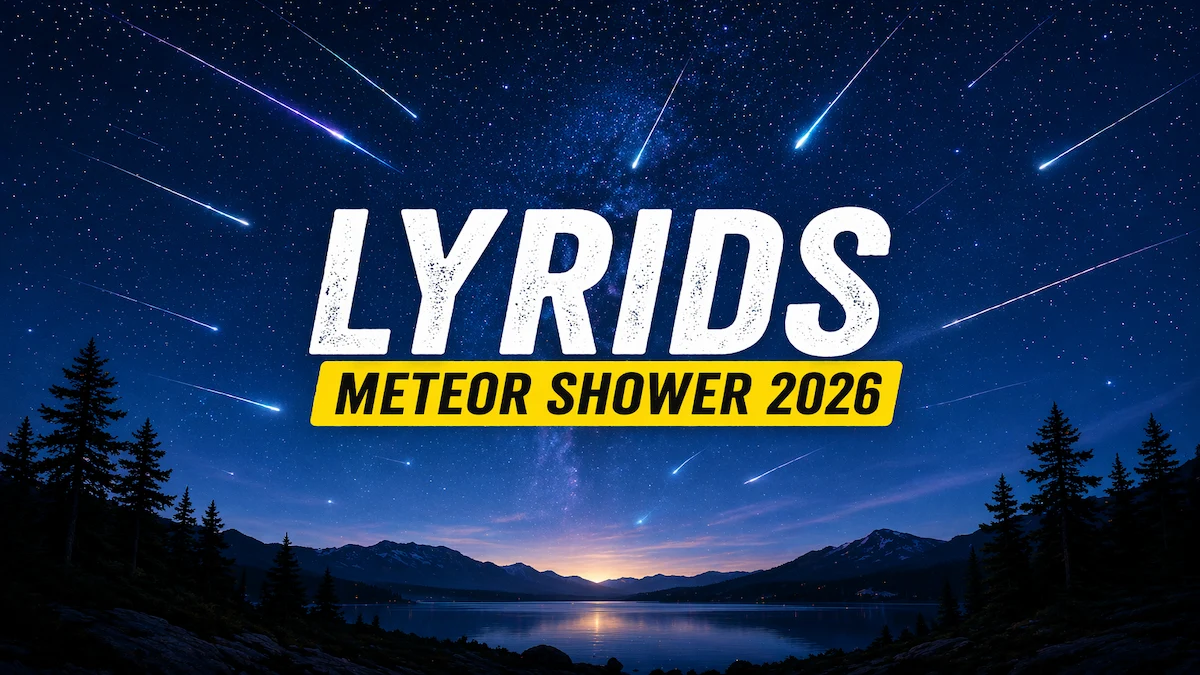
Skywatchers are in for a spectacular celestial treat as the Lyrids Meteor Shower 2026 returns this April with bright streaks of light expected across the night sky. One of the oldest known meteor showers, the Lyrids are famous for fast meteors, occasional fireballs, and sudden bursts of activity that can surprise viewers. The annual event is caused when Earth passes through dust left behind by Comet C/1861 G1 Thatcher. As these tiny particles hit Earth’s atmosphere at high speeds, they burn up and create the glowing trails popularly known as shooting stars.
What Causes the Lyrids Meteor Shower?
The annual cosmic show is the direct result of a dynamic interaction between Earth’s orbital path and the ancient debris field of a long-period comet. The parent body responsible for the Lyrids is Comet C/1861 G1 Thatcher, an icy traveler discovered in 1861 that takes approximately 415 years to complete a single orbit around the Sun.
As Comet Thatcher completes its long journey through the solar system, solar radiation heats its icy core. This heating causes the comet to vent gases and shed a trail of dust, gravel, and rocky debris. This material remains suspended in space, forming a massive debris stream along the comet’s path.
Every year in April, Earth’s 365-day orbit around the Sun brings us directly into this field of space dust. When these tiny particles—most no larger than a grain of sand—collide with Earth’s upper atmosphere, they enter at speeds of roughly 49 kilometers per second (110,000 miles per hour). The extreme speed compresses the air ahead of the particle, generating intense frictional heat that vaporizes the debris and creates the glowing trails of ionized gas that we see from the ground as meteors.
When to Watch the Lyrids Meteor Shower 2026
The Lyrids are active in April each year, with the peak expected around the third week of the month.
1.The Radiant Rises:Late Evening (9:00 PM – 11:00 PM).
The constellation Lyra rises in the northeast. You might catch a few long, slow “earthgrazer” meteors scraping the horizon.
2.Atmospheric Positioning Adjusts:Midnight Transition.
Earth rotates directly into the oncoming debris stream. The frequency of meteors naturally begins to increase.
3.Prime Viewing Hours:Peak Window (2:00 AM – Dawn).
The radiant point climbs to its highest spot in the sky. Visibility hits its peak, making this the best time to spot fast streaks and fireballs.
Expected Meteor Rates and What to Expect
Under dark skies with low light pollution, viewers can typically expect to spot around 10 to 20 meteors per hour during the peak. However, these rates can vary depending on weather and moonlight conditions.
What makes the Lyrids particularly exciting is their capacity for surprises:
- Lyrids Fireballs: The shower is known for producing occasional fireballs—exceptionally bright meteors that can outshine even the planet Venus and cast brief shadows on the ground.
- Persistent Trains: Lyrid meteors often leave behind glowing trails of ionized gas that remain visible for several seconds after the meteor itself has vanished.
- Historical Surges: In rare years, the Lyrids can surprise observers with sudden bursts of activity, occasionally exploding into rates of over 100 meteors per hour. Historic outbursts were recorded in 1803, 1922, and 1982, proving that the debris cloud contains dense clumps of material that Earth occasionally hits.
Finding the Radiant Point: The Constellation Lyra
To locate the origin point of these meteors, skywatchers should look for the constellation Lyra, the celestial harp, from which the shower derives its name. The specific point from which the meteors appear to radiate is near the brilliant blue-white star Vega, one of the brightest stars in the night sky.
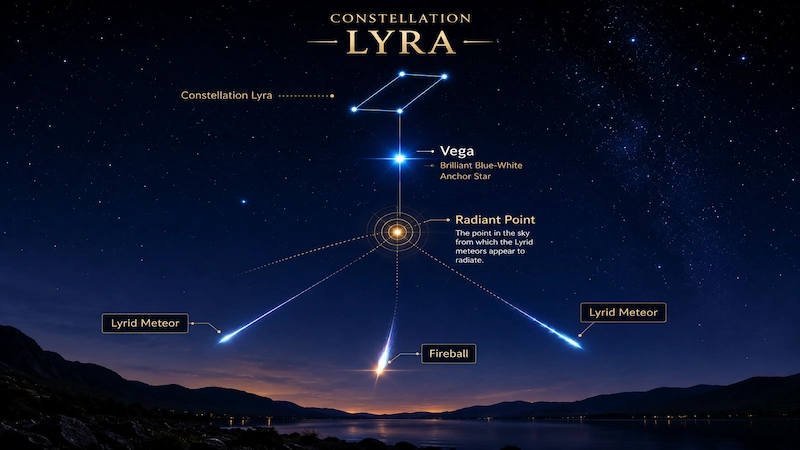
While tracking Vega helps identify the radiant point, experts warn against staring directly at the constellation itself. Meteors that appear near the radiant point have very short paths because they are traveling almost directly toward the observer. To see the longest and most dramatic streaks, it is best to look about 45 degrees away from Lyra, allowing your field of vision to catch meteors as they race across the sky.
Historical Significance of the Lyrids
The Lyrids hold a special place in history as one of the oldest known meteor showers on record. While many popular showers have only been tracked for a few centuries, human records of the Lyrids date back over 2,700 years.
The earliest recorded sighting comes from Chinese astronomers in 687 BC, who noted in ancient texts that on a spring night, “stars fell like rain.” Indigenous cultures, ancient Greek stargazers, and medieval European scholars have all documented the regular return of these spring meteors. This deep historical record provides modern astronomers with valuable long-term data on how comet debris streams shift and decay over thousands of years.
Best Way to See the Meteor Shower
For the best experience, move away from city lights and choose an open area with a wide view of the sky.
- Let Your Eyes Adapt: Allow your eyes around 20 to 30 minutes to adjust to the darkness. This activates your low-light vision, helping you spot the fainter streaks.
- Avoid Your Phone Screen: Looking at a bright smartphone screen will instantly ruin your night vision, forcing you to restart the dark-adaptation process.
- Skip the Equipment: No telescope or binoculars are needed—the naked eye is the best tool for enjoying meteor showers. Optical equipment narrows your view to a tiny window, causing you to miss the meteors flashing across the rest of the open sky.
- Check the Weather: Check local weather forecasts before heading out, as heavy cloud cover can block visibility.
Global Visibility and Tips for Indian Skywatchers
The Lyrids Meteor Shower 2026 can be viewed from both hemispheres, but the Northern Hemisphere offers the absolute best vantage point. Because the constellation Lyra sits high in the northern sky, observers in northern latitudes will see the radiant point climb much higher before dawn.
Viewing Tips for Observers in India
For skywatchers in India, the Lyrids present an excellent pre-monsoon astronomy opportunity. The skies in mid-April are generally dry and clear across most parts of the country before the summer dust storms and seasonal rains roll in.
To escape city light pollution, residents in major hubs like Delhi, Mumbai, Bengaluru, or Chennai should consider traveling to nearby rural areas, open farmlands, or elevated hill stations. Locations like the Western Ghats, the foothills of the Himalayas, or remote parts of Rajasthan provide the dark skies needed to see the fainter Lyrid streaks clearly.
Preparation Checklist for the Ultimate Stargazing Night
To ensure a comfortable, uninterrupted night under the stars, review this practical preparation checklist before heading out to view the Lyrids:
- Pack for the Temperature: Even in April, early morning temperatures can drop significantly; bring a light jacket or a warm blanket to stay comfortable.
- Bring Reclining Chairs: A reclining lawn chair or a thick yoga mat will allow you to lie back comfortably, preventing neck strain while staring straight up.
- Select Red Lighting: If you need a flashlight to navigate in the dark, wrap red cellophane over the lens. Red light does not disrupt your night-adapted vision the way white light does.
- Pack Snacks and Drinks: Stargazing requires patience; bringing a thermos of hot tea or coffee along with light snacks will help you stay warm and alert during the long midnight-to-dawn window.
Also Read: Meteor Shower Explained: What It Is, Types of Meteor Showers & Best Time to Watch Them
For more latest updates on Trending News, Automobile, Education, Technology, Jobs, weather and sports visit IndicDaily.
FAQs: Lyrids Meteor Shower 2026
-
What is the parent body source behind the Lyrids Meteor Shower?
The Lyrids are caused by the debris field left behind by Comet C/1861 G1 Thatcher, a long-period comet that takes roughly 415 years to orbit the Sun.
-
Exactly when will the Lyrids Meteor Shower 2026 peak?
The shower is active throughout April, with the peak expected during the third week of April. The absolute best viewing window on peak night occurs from midnight until the pre-dawn hours.
-
Do I need a telescope or special lenses to view the Lyrids?
No. Using a telescope or binoculars will actually ruin your experience by narrowing your field of view. The naked eye is the best tool because it allows you to monitor the entire open sky for random flashes.
-
How many meteors can I expect to see per hour under dark skies?
During the peak window, observers under dark, rural skies can expect to see roughly 10 to 20 meteors per hour. This rate can fluctuate based on local weather conditions, cloud cover, and moonlight interference.
-
What makes Lyrid meteors different from other annual showers?
The Lyrids are famous for their high speeds, their ability to produce exceptionally bright fireballs, and their long-lasting trails of glowing gas. They also have a history of rare, unpredictable surges in activity.
-
How do astronomers predict the exact dates of a meteor shower’s peak?
Because Earth travels along a highly predictable, mathematically fixed orbit around the Sun, it passes through the exact same spatial coordinates at the same time every single year. By calculating when Earth intersects the densest gravitational core of Comet Thatcher’s left-behind dust stream, orbital mechanics experts can pinpoint the peak arrival time down to the exact hour.