The Southwest Monsoon is the undeniable lifeblood of India’s agricultural framework, economic stability, and water security. However, the macro-climate picture has thrown a severe challenge at the sub-continent. With one of the driest Junes in more than a century behind us—recording a staggering 38% to 39% nationwide rainfall deficit—and the India Meteorological Department (IMD) forecasting below-normal precipitation for July, alarm bells are ringing for the country’s agrarian sectors.
The primary culprit behind this sluggish and strained monsoon cycle is a strengthening El Niño event in the equatorial Pacific Ocean. Historically, El Niño is notorious for disrupting the Walker Circulation, weakening moisture-laden winds, and triggering severe droughts across India.
Yet, as the agricultural heartland faces critical water stress, climate scientists are keeping a eagle-eye focus on a secondary oceanic phenomena that could serve as a late-season savior: The Indian Ocean Dipole (IOD). Often dubbed the “Indian El Niño,” a shift in this massive sea surface temperature gradient has the unique power to completely rewrite a failing monsoon’s script.
Can a developing positive IOD counter the grip of El Niño to rescue India’s rainy season? This deep dive unpacks the current status of the IOD, its underlying physics, and the exact impact it will have on the remainder of the monsoon season.
What is the Indian Ocean Dipole (IOD)?
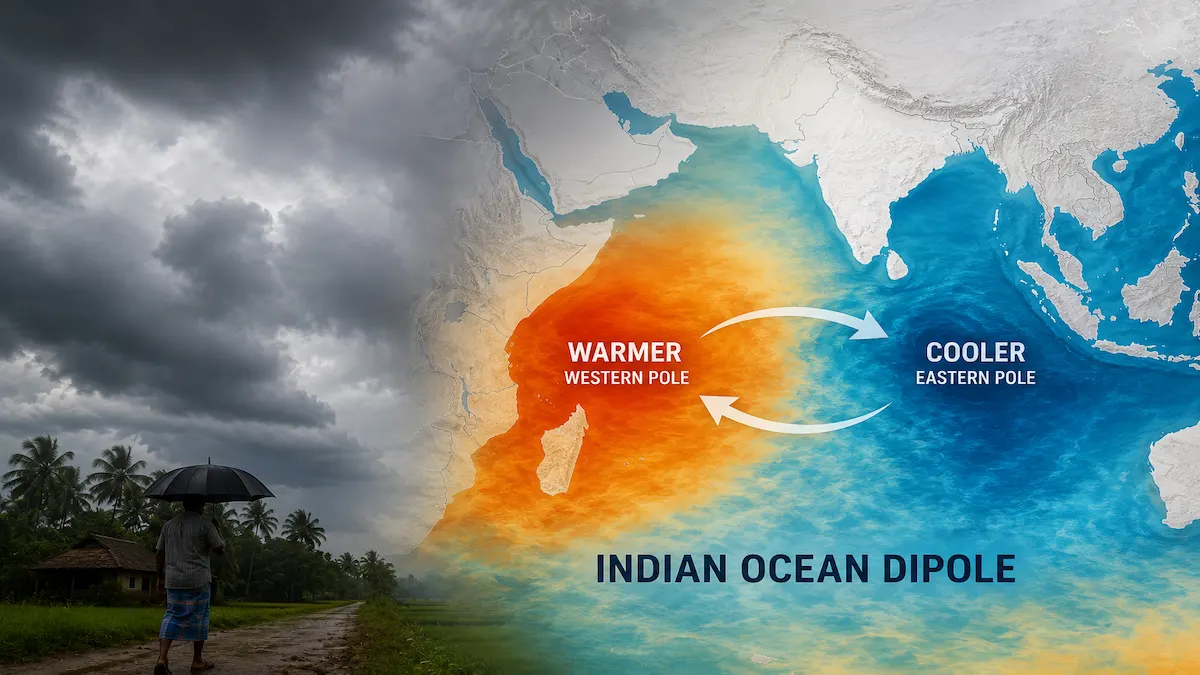
The Indian Ocean Dipole is a complex, large-scale coupled ocean-atmosphere phenomenon occurring across the equatorial Indian Ocean. Much like its Pacific cousin, ENSO (El Niño-Southern Oscillation), the IOD represents a regular shifting of sea surface temperatures (SSTs) and atmospheric pressure systems between two opposite sides of the basin.
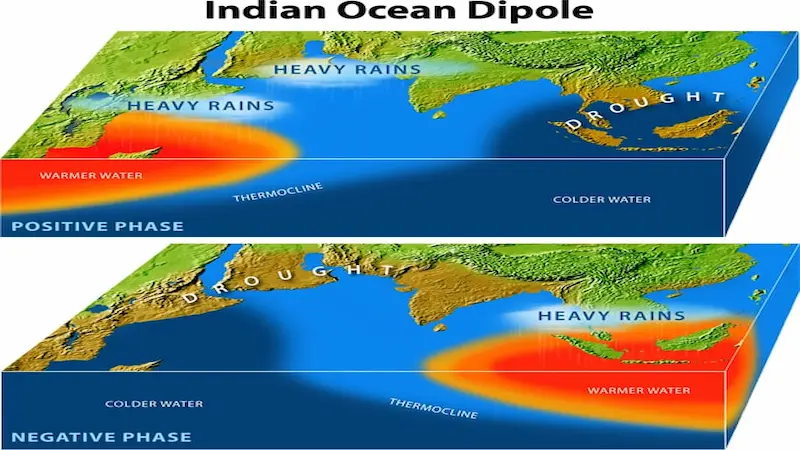
The IOD operates in three distinct phases, each exerting a drastically different influence on the climate of neighboring continents:
- Positive IOD: This phase occurs when the western Indian Ocean (closer to the Arabian Sea and the African coast) becomes abnormally warm, while the eastern Indian Ocean (near Sumatra, Indonesia, and Australia) turns significantly cooler.
- Negative IOD: The exact inverse occurs. The eastern waters near Indonesia warm up, causing moisture-laden winds and rainfall to shift away from the Indian subcontinent, drastically compounding drought conditions.
- Neutral IOD: Sea surface temperatures across the equatorial Indian Ocean remain near historical averages, exerting minimal influence on global or localized monsoon vectors.
The Physics of a Positive Indian Ocean Dipole: How It Enhances Monsoon Rain
When the IOD flips into a strong Positive phase, it unleashes a chain reaction of meteorological events that directly benefits the Indian subcontinent. The process acts as a massive thermal pump for moisture transport.
1. Intensified Convection Over the Arabian Sea
As sea surface temperatures rise in the western Indian Ocean, the air directly above the water heats up, holds more moisture, and rapidly ascends. This intense thermal convection leads to widespread cloud formation and creates powerful low-pressure systems over the Arabian Sea.
2. Boosting the Somali Jet and Cross-Equatorial Flow
The atmospheric pressure differences generated by a positive Indian Ocean Dipole (IOD) dramatically strengthen the low-level Somali Jet. This high-speed wind system acts as an atmospheric superhighway, forcefully steering massive corridors of evaporated, moisture-saturated maritime air directly toward the west coast and central plains of India.
3. Offsetting the Destructive El Niño Mechanism
El Niño suppresses the Indian monsoon by shifting global atmospheric rising zones away from India, causing dry, sinking air to sit over the subcontinent. A positive IOD fights this by establishing its own localized, highly dominant rising air zone over the western Indian Ocean.
Even if El Niño weakens the overall monsoon flow, the positive IOD acts as a powerful local booster, injecting fresh moisture and energy directly into the country’s weather systems.
Current Status of the Indian Ocean Dipole: What the Data Shows
As the monsoon enters its critical mid-season phase, meteorologists from the IMD and international meteorological bodies are closely charting the sea surface anomalies.
Current Phase of Indian Ocean Dipole: Neutral and Marginally Negative
At present, neutral IOD conditions are prevailing across the equatorial Indian Ocean. Long-range data indicates that the Dipole Mode Index (DMI) has hovered near zero or shifted marginally negative during the initial weeks of the monsoon. This lack of an active positive gradient is precisely why India did not get early oceanic protection against the expanding El Niño, resulting in severe early-season rain deficits.
The Emerging Forecast for August and September
While the current status is neutral, advanced dynamic climate models—including the IMD’s high-resolution Monsoon Mission Climate Forecast System (MMCFS) and Australia’s Bureau of Meteorology (BOM) models—are flashing a clear signal of change.
Climate model projections consistently suggest that a positive Indian Ocean Dipole signal is expected to strengthen gradually during the second half of the southwest monsoon. Because IOD events typically mature and peak during the autumn window (September to November), scientists expect a clear positive transition to evolve after July, offering a major late-season boost to rainfall during August and September.
Big Impact Explained: Can It Save the Agricultural Economy?
Because July is historically a heavy contributor to the country’s seasonal rainfall baseline, the current dry spell has already triggered notable ripple effects. The late arrival of steady downpours has disrupted early-stage Kharif sowing, with major crops like rice, pulses, oilseeds, and cotton witnessing significant drops in initial acreage due to low soil moisture.
If the positive IOD develops as projected in late August, its impact will be vital for multiple sectors:
1. Sowing Revival and Crop Survival
A late-season rainfall boost can act as a crucial lifeline for standing Kharif crops that survive the July dry spell. Steady rainfall in late August and September ensures critical moisture during the reproductive and maturity stages of crops, preventing widespread yield failures.
2. Replenishing Critical Reservoirs
India’s industrial, domestic, and agricultural water setups rely completely on the water levels stored in its 150+ central monitoring reservoirs. A late-season surge driven by a positive IOD will boost late reservoir inflows and improve groundwater recharge, securing the irrigation networks needed for the subsequent Rabi (winter) sowing season.
3. Moderating Rural Inflation
A failed monsoon can instantly spark food inflation, strain rural incomes, and slow down broad economic growth. By stepping in to partly salvage total seasonal rainfall percentages, the IOD helps stabilize crop outputs, keeping domestic food prices stable and preserving rural purchasing power.
The Catch: A Caveat from Climate Scientists
While the projected emergence of a positive IOD brings a welcome wave of optimism, climate experts urge caution against treating it as an absolute guarantee.
First, the projected positive IOD event for later this year is currently modeled as moderate, not extreme. A moderate IOD possesses the strength to partially offset or soften the blow of a strengthening El Niño, but it rarely possesses the raw energy to completely neutralize a severe, deep-seated Pacific warming event.
Second, the structural distribution of rainfall under a late-developing IOD can be highly uneven. Even if total nationwide percentages crawl back to normal zones by late September, certain central or western agricultural belts might still experience localized water stress, while other pockets face sudden, heavy downpours that pose localized flood risks.
A High-Stakes Natural Balancing Act
The monsoon cycle stands as a masterclass in global climate connections, showing how temperature variations in the distant Pacific and local Indian Oceans directly shape the livelihoods of millions of families across India.
While the early grip of El Niño has deal a tough blow to the initial stages of the monsoon, the anticipated shift toward a positive Indian Ocean Dipole offers a genuine ray of hope. As we move deeper into the high-stakes months of August and September, the evolving temperature patterns of the Indian Ocean will ultimately determine whether India can navigate past an early drought threat and secure a resilient agricultural finish.
Also Read: Cyclone Explained: What It Is, Types, How It Forms & Why It’s So Dangerous
For more latest updates on Trending News, Automobile, Education, Technology, Jobs, weather and sports visit IndicDaily.
FAQs: Indian Ocean Dipole and Monsoon Impact
-
What is a positive Indian Ocean Dipole (IOD) and how does it help India?
A positive IOD occurs when the western Indian Ocean becomes warmer than the eastern part. This temperature difference increases evaporation and strengthens atmospheric convection over the Arabian Sea, pumping massive corridors of moisture-laden winds into India to boost monsoon rainfall.
-
Can a positive IOD completely neutralize the effects of an El Niño?
Not always. While a strong positive IOD can completely override a weak El Niño (as famously seen during the historic 1997 monsoon), a moderate positive IOD typically acts as a partial buffer—softening the severe deficit and bringing vital late-season rain without completely erasing El Niño’s overall impact.
-
What is the current status of the IOD?
The Indian Ocean Dipole is currently sitting in a neutral phase. Because it lacked a strong positive setup during June and early July, it was unable to block the initial drying effects of El Niño, leading to the country’s slow and deficit-heavy start to the monsoon season.
-
When is the positive IOD expected to develop and impact rainfall?
Advanced climate models indicate that a positive IOD signal is expected to develop and strengthen during the second half of the rainy season, likely showing its clear, beneficial impacts on sub-continental rainfall patterns during August and September.
-
How does a delayed or weak monsoon affect India’s agriculture?
A sluggish start to the monsoon reduces vital soil moisture and slows down the sowing of crucial summer (Kharif) crops like rice, pulses, and soybeans. It also depletes central water reservoir levels, which can complicate irrigation for winter crops if late-season rains fail to arrive.