For over six decades, withdrawing money from your Employees’ Provident Fund (EPF) account was notorious for being a tedious, paperwork-heavy process. Employees routinely faced long waiting periods, mandatory employer interventions, and frequent claim rejections.
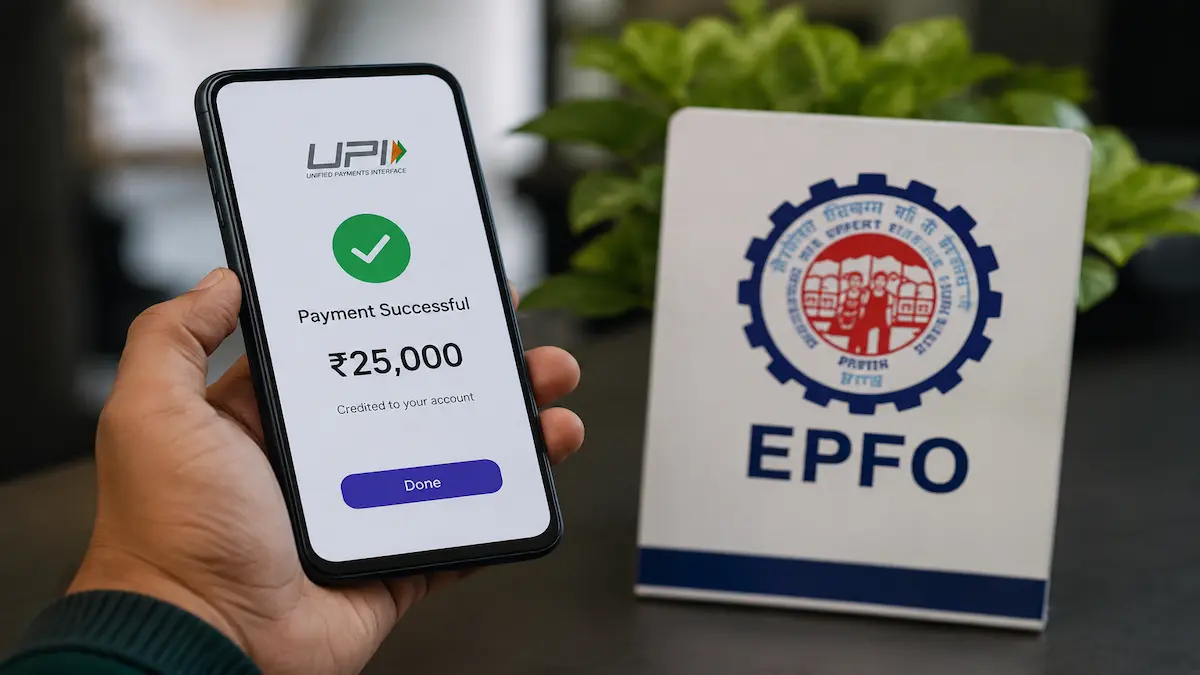
However, the Employees’ Provident Fund Organisation (EPFO) has completely overhauled its digital infrastructure. Under the newly rolled out EPFO 3.0 framework, the organization has integrated with the National Payments Corporation of India (NPCI) to introduce an instant UPI-based withdrawal feature.
This modernization essentially turns your retirement fund into a highly accessible, virtual banking tool for unexpected emergencies while safeguarding your long-term retirement goals. This article breaks down everything you need to know about the EPFO UPI withdrawal feature, including its rules, limits, and how to utilize it.
What is EPFO 3.0?
EPFO 3.0 represents a major member-centric digital transformation. Built on a cloud-native, API-first architecture, this advanced platform treats your EPF account more like a modern bank account.
By tying up with 32 public and private sector banks, the system transitions away from slow legacy software to enable real-time tracking, AI-powered multi-lingual assistance, and automation. While the platform introduces several game-changing changes—like raising the auto-settlement limit for claims up to ₹5 lakh—the headline feature is the ability to securely pull funds via Unified Payments Interface (UPI).
Key Features and Rules of UPI PF Withdrawals
While the UPI feature provides unprecedented liquidity, the government has established strict guardrails to prevent members from depleting their retirement savings prematurely.
1. The 75% Withdrawal and 25% Lock-in Rule
Active employees cannot wipe out their entire PF balance through UPI. The system divides your corpus into a “Withdrawable Balance” and a “Locked Retirement Balance.”
- You can instantly withdraw up to 75% of your total EPF balance (which includes both your contribution, your employer’s contribution, and the accumulated interest) via UPI for immediate needs.
- A minimum 25% balance must remain locked in the account at all times as a mandatory buffer for retirement.
2. Elimination of Employer Attestation
Historically, the biggest bottleneck in partial PF withdrawals was waiting for the employer’s digital approval or signature. Under EPFO 3.0, no employer approval is required for standard digital claims. Instead, the platform relies entirely on Aadhaar-based OTP verification and self-certification, empowering employees to access their own money directly.
3. Consolidated Claims and Self-Certification
EPFO has compressed 13 complex withdrawal categories down to 3 simplified streams:
- Essential Needs (Medical emergencies, marriage, education)
- Housing (Purchase of land/house, home construction, or home loan repayment)
- Special Circumstances (Unemployment, natural disasters)
Instead of uploading endless supporting physical documents, members can now simply check a self-certification box on the portal or app to state their reason for withdrawal.
4. Unemployment Exceptions
If you face sudden job loss, the new rules allow you to withdraw 75% of your total corpus after just one month of continuous unemployment. If you remain unemployed for a second consecutive month, you are then permitted to settle the remaining 25% for a full 100% account closure.
Eligibility Criteria: Prerequisites for UPI Withdrawals
To ensure your UPI withdrawal goes through successfully without getting stuck in transaction failures, your account profile must meet these absolute technical requirements:
- Active UAN: Your Universal Account Number must be fully activated and operational on the EPFO member portal.
- Aadhaar Seeding: Your UAN must be securely linked to your Aadhaar card.
- Active Mobile Number: The mobile number registered with your UAN must match your Aadhaar-linked mobile number to smoothly receive the double-factor OTP authentication.
- Complete KYC: Your digital profile must show verified green ticks for Aadhaar, PAN, and Bank Details.
- PAN Linkage: Ensure your PAN is linked to prevent a heavy Tax Deducted at Source (TDS) rate of 30% if your total continuous service history is under 5 years.
Step-by-Step Guide to Withdrawing PF Online via UPI
The system processes standard partial claims under ₹5 lakh within 24 hours, with smaller UPI transfers often arriving within hours or minutes. Follow this step-by-step process to initiate a withdrawal.
1.Verify KYC Status:Prerequisite Step.
Log in to the EPFO Member Unified Portal using your UAN and password. Navigate to Manage > KYC and ensure your Aadhaar, PAN, and Bank Account details are fully verified and active.
2.Access the Claim Section:Initiating Request.
Go to the top navigation bar and select Online Services > Claim (Form-31, 19, 10C & 10D). Verify your registered bank account details by typing the last four digits of your account number when prompted.
3.Select Payout Mode:Choosing UPI.
Under the “I want to apply for” drop-down menu, choose Advance Claim (Form 31). In the payout options, select Payout via UPI instead of the traditional bank account transfer.
4.Enter Details & UPI ID:Validation Phase.
Select your withdrawal purpose category (e.g., Medical Emergency, Marriage) and input the exact amount required. Enter your virtual payment address (UPI ID). The system will automatically run a real-time name matching check against your EPF records.
5.Aadhaar OTP Authentication:Final Submission.
Click on “Get Aadhaar OTP”. Enter the unique code sent to your Aadhaar-registered mobile phone number, accept the self-certification terms, and click Submit. Your request is securely routed through the NPCI network for near-instant processing.
Important Limits to Keep in Mind
While UPI gives rapid access, it operates within strict boundaries. Ensure your financial expectations match the statutory framework outlined below:
| Feature/Parameter | Prescribed Limit / Rule under EPFO 3.0 |
| Maximum UPI Advance Limit | Up to 75% of the total account balance. |
| Mandatory Account Floor | 25% of the total corpus must remain untouched. |
| Auto-Settlement Threshold | Claims up to ₹5 Lakh are processed instantly without human intervention. |
| Marriage Withdrawal Cap | Allowed up to 5 times maximum across your entire career tenure (Requires 7 years of service). |
| Education Withdrawal Cap | Allowed up to 10 times maximum during your service period (Requires 7 years of service). |
| Taxation Rule (TDS) | Exempt after 5 years of service; TDS applies if under 5 years for amounts exceeding ₹50,000 without PAN. |
Things to Check Before Clicking Submit
To prevent your transaction from getting flagged or rejected by the automated system, double-check these three common error points:
1. Name Match Consistency: The name on your EPF account, your Aadhaar card, your linked bank account, and your UPI handle registration must match exactly. Minor spelling discrepancies or missing middle names will trigger automated security rejections.
2. The 7-Year Rule for Milestones: While medical emergencies can be self-certified at any time, specialized partial advances for marriage or higher education require a minimum of 7 accumulated years of EPF contribution service.
3. Passbook Real-Time Check: Use the newly launched Passbook Lite feature on the member portal or the UMANG app to check your live balance, transaction history, and exact withdrawable limits before writing an advance amount.
By integrating standard digital banking tools like UPI, the EPFO has successfully removed major administrative hurdles for millions of formal sector workers across India. Ensure your KYC details are clean and updated so you can use this frictionless, instant emergency cash option whenever the need arises.
Also Read: 8th Pay Commission Big Update: DA Merger Demand, HRA Revision and Allowance Hike
FAQs: EPFO UPI Withdrawals
-
Can I withdraw 100% of my PF balance via UPI under EPFO 3.0?
No, active employees cannot withdraw 100% of their PF balance through UPI. Under the new EPFO 3.0 guidelines, you can instantly withdraw a maximum of 75% of your total EPF balance for immediate financial needs. A minimum balance of 25% must remain locked in your account at all times to secure your long-term retirement savings. Complete 100% withdrawal is only permitted upon official retirement or after two consecutive months of continuous unemployment.
-
How long does it take for the PF money to hit my bank account via UPI?
While traditional PF claims used to take anywhere from 7 to 20 days, the EPFO 3.0 framework utilizes a cloud-native, automated IT system linked with the National Payments Corporation of India (NPCI). Standard advance claims under ₹5 lakh are processed through an auto-settlement mechanism. Once authenticated via Aadhaar OTP, eligible UPI transactions are settled within hours or minutes, vastly reducing the waiting period for emergencies.
-
Is employer approval required to withdraw PF money using UPI?
No, employer attestation or digital approval is not required for standard partial withdrawals under EPFO 3.0. The revamped system relies strictly on digital self-certification and dual-factor Aadhaar OTP authentication. As long as your UAN is active, seeded with Aadhaar, and your KYC reflects verified details, you can pull your funds directly without coordinating with your company’s HR department.
-
Why am I getting an “Amount Exceeds Limit” error during my EPFO UPI withdrawal?
This error typically occurs due to a mismatch between two different caps:
The EPFO Cap: You might be trying to request an advance amount higher than the permissible 75% limit of your available corpus.
The Bank/UPI Channel Cap: Standard banking channels restrict daily UPI transactions to ₹1 lakh or ₹2 lakh depending on your specific bank’s policy. If your approved PF advance is large (e.g., ₹3 lakh), trying to route it through a single UPI pull will fail. For amounts closer to the ₹5 lakh auto-settlement limit, choose the traditional bank transfer option (NEFT/RTGS) instead of UPI.
-
Will I be charged tax (TDS) on instant UPI PF withdrawals?
Taxability does not depend on the payment method (UPI vs. Bank Transfer), but on your tenure of service. If you have completed 5 years of continuous service, your PF withdrawal is entirely tax-free. However, if your total service history is less than 5 years and your withdrawal amount exceeds ₹50,000, Tax Deducted at Source (TDS) will apply. Ensure your PAN is linked to your UAN to limit the TDS deduction to 10%; otherwise, an unlinked PAN will trigger a maximum marginal tax rate of 30%.
Stay Ahead with IndicDaily
Loved this guide? IndicDaily.com brings you sharp, simplified updates on India’s financial policies, digital tech, and personal finance rules.
- Bookmark IndicDaily.com for your daily dose of actionable insights.
- Share this article with colleagues and friends who need quick access to their PF funds.
Never miss a crucial policy update—stay informed, stay ahead!