he ancient Jurassic oceans were highly unforgiving environments, ruled by massive apex predators that relied on speed, power, and razor-sharp precision to dominate the marine food chain. However, a remarkable new paleontological breakthrough from Germany has revealed that survival in these prehistoric waters required more than just brute strength—it demanded jaw-dropping evolutionary resilience.
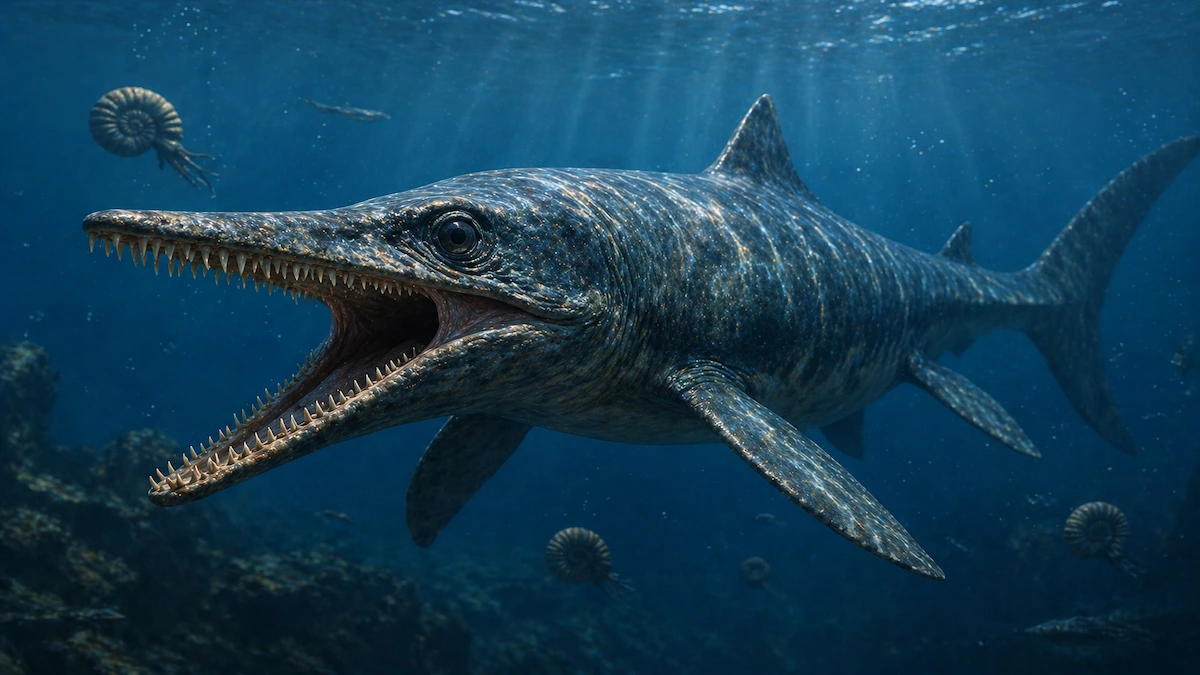
Scientists studying an exceptionally well-preserved 180-million-year-old ichthyosaur fossil have revealed shocking details about an ancient predator that roamed Earth’s oceans during the Jurassic Period. This prehistoric creature was a formidable force, armed with a jaw containing around 100 sharp, conical teeth. What makes this specific discovery a historic marvel is not just its predatory profile, but its incredible story of survival. The structural analysis of the fossil reveals that this “sea monster” used a unique and highly clever survival strategy: swallowing stones to help digest its food and maintain balance in water.
What Is an Ichthyosaur? The Ancient Oceanic Reptile
Ichthyosaurs were powerful marine reptiles that lived millions of years ago, long before humans existed. Although they occupied a similar ecological niche to today’s sharks and killer whales, they belonged to a completely distinct lineage of reptiles that returned to the sea during the early Mesozoic Era.
These creatures were among the top predators of ancient oceans, capable of swimming at high speeds and hunting efficiently across vast distances. The recently studied fossil dates back around 180 million years, offering rare insights into how these animals lived, hunted, and adapted to harsh marine environments.
The Biological Marvel: Comparing Ichthyosaurs to Modern Dolphins
To the untrained eye, looking at a reconstructed skeleton of an ichthyosaur feels instantly familiar. This is because ichthyosaurs represent one of the most famous examples of convergent evolution in the natural world. Convergent evolution occurs when two completely unrelated species evolve similar physical traits because they adapt to the exact same environmental challenges.
Prehistoric Reptile Ancestor ──> Adapts to Open Ocean ──> Ichthyosaur (Streamlined, Dorsal Fin)
Ancient Terrestrial Mammal ──> Adapts to Open Ocean ──> Modern Dolphin (Streamlined, Dorsal Fin)
While they resembled modern dolphins in body shape, side fins, and tail structures, ichthyosaurs were actually reptiles, not mammals. Unlike dolphins, which must surface frequently to breathe air through a blowhole, ichthyosaurs maintained large, modified lungs but lacked the mammalian nursery systems. They also possessed massive eyes stabilized by a ring of bone—known as a sclerotic ring—to help them see in the pitch-black depths of the deep sea. By comparing the two, scientists can see how nature repeatedly lands on the same perfect, streamlined design for high-speed underwater hunting.
A Predator with 100 Teeth: Built for the Kill
One of the most striking features of this newly analyzed ichthyosaur specimen is its elongated, narrow jaw, which contained around 100 individual teeth. These teeth were perfectly adapted for an active, predatory lifestyle:
- Sharp and Conical Geometry: Ideal for puncturing flesh without breaking under pressure.
- Perfect for Catching Slippery Prey: Designed to grip smooth, fast-moving aquatic life.
- Engineered to Secure Fish and Squid: Ensuring that once prey was gripped, it could not slip away in the water.
This dental structure confirms that the ichthyosaur was an active hunter, feeding heavily on fast-moving marine animals. Its long snout and strong bite made it a highly effective apex predator in Jurassic seas, allowing it to snap at passing schools of fish with lightning speed.
The Secret to Survival: Why Did It Swallow Stones?
Despite its fearsome array of 100 teeth, researchers found something highly unusual resting inside the fossilized abdominal region of the creature—small stones. These stomach stones, known scientifically as gastroliths, played an important role in the animal’s daily survival.
For an open-water reptile, swallowing heavy rocks seems counterintuitive. However, this behavior was a clever adaptation that significantly increased its chances of survival in a highly competitive marine ecosystem.
The Physics of Gastroliths: How Internal Milling and Buoyancy Work
The purpose of swallowing stones goes far beyond simple ingestion; it can be broken down into two distinct mechanical and physical processes:
1. The Internal Milling Process
Because an ichthyosaur’s teeth were sharp and conical, they were designed exclusively for grabbing and tearing, not chewing. Food had to be swallowed completely whole. Once inside the stomach, the heavy gastroliths acted as an internal grinding mill. As the stomach walls contracted to process a meal, the stones rubbed against each other, mechanically mashing up unchewed fish scales, bones, and soft tissues to speed up nutrient absorption.
2. Buoyancy Control and Stabilizing the Body
In physics, staying underwater requires a delicate balance between floating and sinking. Swallowing stones provided the ichthyosaur with a natural ballast system. The extra weight in its core:
- Helped improve buoyancy control in deep water.
- Stabilized the body while swimming through turbulent currents.
- Allowed the creature to dive efficiently without expending excessive muscle energy.
The Fossilization Window: How a 180-Million-Year-Old Specimen Survived Intact
Finding fossilized bones is rare, but finding a fossil that clearly preserves the stomach contents of an animal from 180 million years ago is an absolute miracle. This incredible preservation depends entirely on the environment where the creature died.
When this ichthyosaur died, its body sank to the ocean floor and was quickly buried under fine, low-oxygen sediment and clay layers. Because there was very little oxygen at the bottom of the ancient basin, scavengers and bacteria could not decompose the carcass completely. Over millions of years, the surrounding mud compacted into stone, locking the heavy gastroliths securely inside the ribs exactly where they sat during the creature’s final hours. This pristine fossilization window provides scientists with a clear, unaltered look into prehistoric biology.
What This Discovery Reveals About Evolution
This fossil is not just another prehistoric find—it provides a deeper, more sophisticated understanding of marine life during the Jurassic era. Scientists believe this discovery shows:
- Advanced Feeding Strategies: Ancient predators used behavioral modifications to maximize their caloric intake.
- Evolution of Digestion Techniques: Showing how early marine reptiles solved the problem of processing whole food without molar teeth.
- Complex Survival Adaptations: Proving that evolutionary survival required a balance of structural weapons (like teeth) and behavioral habits (like stone swallowing).
The Modern Equivalents: Which Living Creatures Still Use This Strategy?
While an ichthyosaur with 100 teeth swallowing stones sounds like something out of science fiction, this unique survival strategy never actually went extinct. This behavior is still clearly seen in several modern animals today.
Crocodiles and alligators regularly swallow heavy stones to help them stay anchored at the bottom of riverbeds while waiting to ambush prey. Similarly, many modern bird species—including ostriches and chickens—swallow small pebbles into an organ called a gizzard to grind up tough seeds and plants. Seeing the exact same strategy in a 180-million-year-old marine reptile proves that nature has always been highly innovative and consistent when solving evolutionary problems.
Life in the Jurassic Oceans: A Highly Competitive Realm
Around 180 million years ago, Earth’s oceans were full of life and incredibly dangerous. Marine reptiles like ichthyosaurs shared the waters with a diverse array of species:
- Plesiosaurs: Long-necked marine reptiles that used ambush tactics to catch fish.
- Ammonites: Hard-shelled, squid-like mollusks that filled the middle of the food chain.
- Early Fish Species: Fast-swimming, armored fish that served as the primary food source for top predators.
In this competitive ecosystem, the ichthyosaur stood out as one of the fastest and most dangerous hunters, using its streamlined body and specialized biology to hold its ground at the top of the food chain.
Why This Discovery Matters Today
Findings like this help scientists understand how life evolved on Earth. By studying fossils, researchers can reconstruct ancient ecosystems and learn how species adapted to severe environmental challenges over millions of years. This ichthyosaur fossil, with its sharp teeth and swallowed stones, serves as a great reminder that survival strategies have always been the primary driving force behind evolution.
As research continues, fossils like this will keep revealing secrets of a world that existed long before humans — yet still shapes our understanding of life today.
Also Read: Nanaimoteuthis Mystery Revealed: Ancient Giant Sea Predator That Ruled Prehistoric Oceans
FAQs: The 180-Million-Year-Old Ichthyosaur Discovery
-
What is an ichthyosaur?
An ichthyosaur is an extinct marine reptile that lived during the age of dinosaurs. While it resembled modern dolphins in shape and swam at high speeds, it was a true reptile rather than a mammal.
-
How old is the discovered ichthyosaur fossil?
The studied fossil is approximately 180 million years old, dating back to the Jurassic Period.
-
Why did the ichthyosaur swallow stones?
The ichthyosaur swallowed stones (gastroliths) to serve as an internal grinding mill to help digest unchewed food, control its underwater buoyancy, and stabilize its body while swimming.
-
How many teeth did this ichthyosaur have?
The studied specimen featured an elongated jaw packed with around 100 sharp, conical teeth, which were perfect for catching slippery fish and squid.
-
Do any modern animals still swallow stones to survive?
Yes. This behavior can still be observed in modern animals today, including crocodiles, alligators, and various bird species that use stones to grind down food or manage balance.