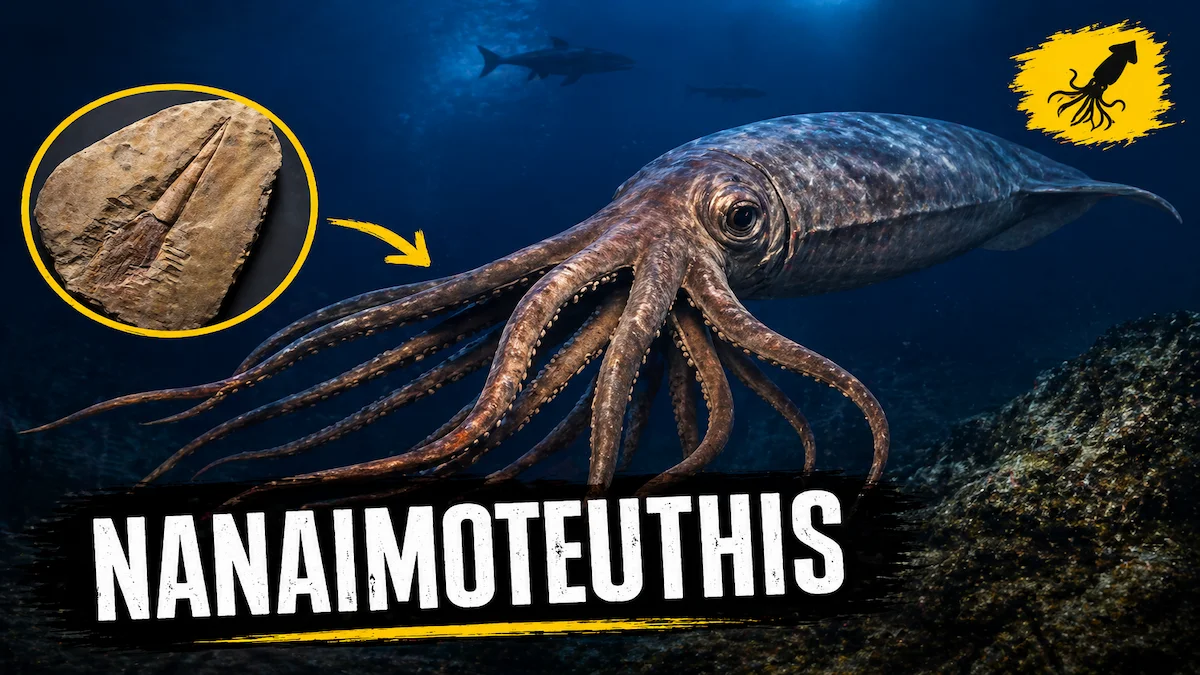
The prehistoric oceans were a theater of ceaseless evolutionary warfare. While the terrestrial world of the Mesozoic Era is famously remembered for the dominance of massive dinosaurs, the marine realms were arguably more competitive, volatile, and prone to rapid evolutionary shifts. For over a century, the popular narrative of ancient marine life centered primarily around armored giants: the hard-shelled ammonites, the toothy marine reptiles like mosasaurs and plesiosaurs, and early predatory sharks.
However, a groundbreaking paleontological discovery has completely transformed our understanding of the soft-bodied masters of the deep. Enter Nanaimoteuthis, a newly detailed genus of ancient cephalopod that represents a critical evolutionary missing link. Living during the Late Cretaceous period, this extraordinary creature provides scientists with concrete answers to how modern squids, octopuses, and cuttlefish—collectively known as coleoids—shed their heavy external armor to become the sleek, intelligent, jet-propelled predators we know today.
This comprehensive analysis explores the anatomy of Nanaimoteuthis, the geological landscape it inhabited, the mechanics of its internal shell evolution, and its enduring impact on modern evolutionary biology.
What is Nanaimoteuthis? Classifying the Mesozoic Jet-Setter
To fully appreciate Nanaimoteuthis, one must first understand its place within the broader tree of life. It belongs to the class Cephalopoda, a group of highly intelligent mollusks characterized by bilateral body symmetry, a prominent head, and a set of arms or tentacles modified from the primitive molluscan foot.
While ancient cephalopods like the nautilus and ammonites chose the evolutionary path of heavy, chambered external shells for defense, Nanaimoteuthis was a pioneer of an entirely different strategy. It belonged to the subclass Coleoidea. Instead of hiding inside a protective fortress, these creatures internalized their shells, allowing their soft muscle tissue to grow around the hard structure.
Taxonomic Hierarchy of the Genus
- Kingdom: Animalia
- Phylum: Mollusca
- Class: Cephalopoda
- Subclass: Coleoidea
- Order: Vampyromorpha (or closely allied ancestral lineages)
- Genus: Nanaimoteuthis
Nanaimoteuthis is characterized by an elongated, highly streamlined body design built for rapid underwater acceleration. Rather than relying on drift or passive buoyancy, it was an active, agile hunter that occupied a specialized ecological niche in the middle to upper zones of the water column.
The Discovery Site: Unlocking the Secrets of the Pacific Northwest
Fossils of soft-bodied creatures like squids are among the rarest treasures in paleontology. Unlike dinosaurs, whose dense bones can endure millions of years of mineralization, a cephalopod’s flesh dissolves rapidly after death, leaving behind virtually nothing. The discovery of Nanaimoteuthis was made possible only by a highly specific, miraculous combination of geological conditions.
The primary specimens of Nanaimoteuthis were recovered from the Nanaimo Group, a thick sequence of sedimentary rocks exposed along the eastern coast of Vancouver Island and the Gulf Islands in British Columbia, Canada. These rocks date back to the Late Cretaceous period, roughly 85 to 65 million years ago.
The Power of Lagerstätten Preservation
During the Late Cretaceous, this region was a dynamic, deep-water forearc basin known as the Nanaimo Basin. The ocean floor here was characterized by high sedimentation rates and localized zones of extreme oxygen depletion (anoxia).
When a Nanaimoteuthis died and sank to the muddy floor of this basin, it was quickly blanketed by fine-grained silts and clays before scavengers or oxygen-dependent bacteria could tear the carcass apart. Over millions of years, the intense pressure compressed the organic tissues into ultra-thin carbon films, preserving the exquisite silhouettes of the animal’s mantle, fins, and most importantly, its internal shell structure. This exceptional level of preservation provides scientists with a window into prehistoric soft-tissue anatomy that regular fossil beds simply cannot match.
The Internal Shell: The Ultimate Evolutionary Gamble
The defining feature of Nanaimoteuthis—and the primary reason for its immense scientific value—is its gladius or internal shell. In modern squids, the gladius (often called the pen) is a clear, feather-shaped structure made of chitin that runs along the length of the mantle, acting as an internal backbone to support the muscles during high-speed swimming.
In Nanaimoteuthis, scientists found an evolutionary halfway point. Its internal shell was not yet the purely flexible, plastic-like pen found in modern squids, nor was it the heavy, calcified cuttlebone of a cuttlefish. Instead, it was a robust, semi-calcified internal structure that provided substantial structural support while drastically minimizing the creature’s overall weight.
[External Shell: Ammonite] ──> Heavy armor, slow movement, maximum protection.
│
▼
[Internalized Shell: Nanaimoteuthis] ──> Semi-calcified gladius, high speed, high agility.
│
▼
[Modern Squid Gladius] ──> Pure chitin pen, maximum flexibility, extreme jet-propulsion.
By moving its shell inside its body, Nanaimoteuthis made a massive evolutionary gamble: it traded passive, armor-plated defense for raw, unadulterated speed. This trade-off allowed it to evade larger predators like sharks and mosasaurs through agile maneuvering rather than trying to withstand a crush injury inside a shell.
The Mechanics of Cretaceous Jet-Propulsion
Freed from the structural restrictions of a heavy external shell, Nanaimoteuthis developed a highly efficient method of locomotion that mirrors modern squids: jet-propulsion.
The creature’s muscular mantle cavity functioned as a powerful water pump. By expanding the mantle, Nanaimoteuthis would draw a massive volume of seawater into its body. It would then tightly seal its mantle edge and violently contract its thick muscle walls, forcing the trapped water out through a narrow, highly flexible muscular tube called the siphon or hyponome.
According to hydrodynamic modeling of its body shape, this mechanism allowed Nanaimoteuthis to execute lightning-fast backward bursts of acceleration. This made it a highly lethal ambush predator, capable of snapping up small fish, crustaceans, and open-water larvae before its prey could detect its presence. Furthermore, its internal gladius provided the rigid baseline needed to prevent its soft body from collapsing under the intense muscular pressure of these sudden aquatic jets.
The Biological Marvel: Convergent Evolution and Large Eyes
Much like its contemporary marine neighbors, Nanaimoteuthis relied heavily on sensory perception to navigate the dim, deep waters of the Nanaimo Basin. Fossil impressions reveal that this genus possessed remarkably large, sophisticated eyes relative to its total body size.
The development of advanced eyes in Nanaimoteuthis is a classic example of convergent evolution. Because it shared the deep ocean with fast, visually acute hunters, it needed a way to spot predators from a distance and track tiny, bioluminescent, or camouflaged prey in low-light environments.
Its large eyes were likely backed by a complex nervous system, giving it the rapid processing speeds needed to alter its swimming trajectory mid-jet. This combination of advanced vision and high agility turned Nanaimoteuthis into one of the most successful soft-bodied stealth hunters of the Late Cretaceous.
Why Nanaimoteuthis Matters: The Great Coleoid Radiation
The discovery of Nanaimoteuthis is a crucial puzzle piece for scientists studying the Mesozoic Marine Revolution—a prolonged geological era marked by a massive escalation in predator-prey relationships. During this time, predators developed increasingly powerful shell-crushing jaws, forcing shelled organisms to either evolve thicker armor or find a new way to survive.
Nanaimoteuthis proved that escaping the shell entirely was a viable, highly successful strategy. Its emergence coincided with the great radiation of modern coleoids. While the heavy, slow-moving ammonites were completely wiped out by the mass extinction event at the end of the Cretaceous period, the sleek, adaptable descendants of lineages like Nanaimoteuthis sailed through the extinction matrix virtually unscathed. Their speed, deep-water adaptability, and non-reliance on calcium carbonate shells allowed them to inherit the post-extinction oceans, paving the way for the rich diversity of modern squids and octopuses we see today.
The Lasting Legacy of a Ancient Masterpiece
The story of Nanaimoteuthis is a brilliant reminder of nature’s capacity for radical innovation. When faced with an ocean full of armored giants and bone-crushing jaws, this remarkable cephalopod chose to shed its armor, step out into the open water, and rely entirely on speed, agility, and intelligence to survive.
Thanks to the pristine preservation conditions of the Nanaimo Group, paleontology has been handed an invaluable blueprint of cephalopod evolution. Nanaimoteuthis bridges the ancient world of hard-shelled mollusks with the dynamic, soft-bodied masters of our modern oceans, solidifying its place as one of the most fascinating success stories in the history of life on Earth.
FAQs: The Nanaimoteuthis Fossil Breakthrough
-
What kind of animal was Nanaimoteuthis?
Nanaimoteuthis was an ancient, soft-bodied marine cephalopod that lived during the Late Cretaceous period. It is a member of the subclass Coleoidea, making it an ancestral relative of modern squids, octopuses, and cuttlefish.
-
Where were the fossils of Nanaimoteuthis discovered?
The primary specimens were excavated from the Nanaimo Group, a series of sedimentary rock formations located along the eastern coast of Vancouver Island and the neighboring Gulf Islands in British Columbia, Canada.
-
What makes the shell of Nanaimoteuthis unique compared to an ammonite?
Unlike ammonites, which lived inside heavy, coiled external shells, Nanaimoteuthis possessed a semi-calcified internal shell called a gladius. This structure was entirely enclosed by its muscular mantle, sacrificing heavy armor protection in exchange for extreme underwater speed and agility.
-
How did Nanaimoteuthis move through the prehistoric oceans?
It utilized an advanced method of jet-propulsion. By drawing water into its muscular mantle cavity and forcefully expelling it through a flexible, narrow siphon, the creature could achieve sudden, high-speed bursts of backward acceleration to hunt or escape predators.