
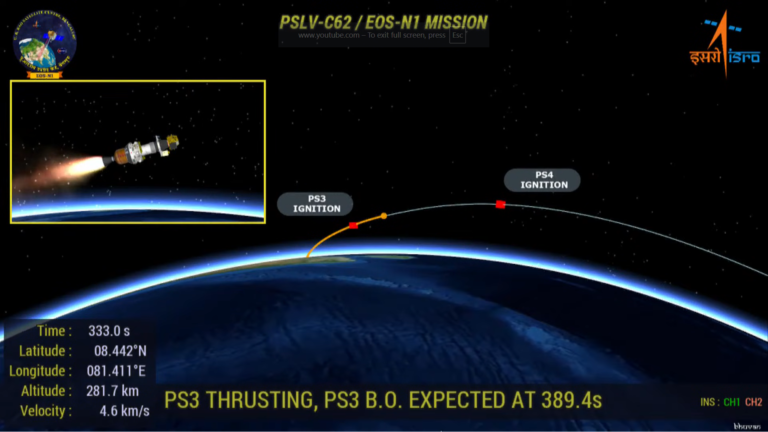
The Indian Space Research Organisation (ISRO) encountered an unexpected setback on January 12, 2026, after its PSLV-C62 launch mission failed to deploy 16 satellites into their designated orbit. The mission was designed to place the EOS-N1 (Anvesha) Earth observation satellite, developed for the Defence Research and Development Organisation (DRDO), along with 15 additional payloads into a sun-synchronous orbit. Although the launch began smoothly, a technical anomaly during flight led to mission failure.
Table of Contents
Successful Takeoff, Issue During Third Stage
The PSLV-C62 rocket lifted off successfully from the Satish Dhawan Space Centre in Sriharikota, with its initial flight phases performing as planned. The first and second stages executed nominally, including proper booster separation and trajectory alignment. However, near the conclusion of the third stage (PS3) — which uses solid propellant — engineers detected abnormal behavior in the vehicle’s movement, including irregular roll motion and deviation from the intended flight path.
Third Stage Malfunction Identified as Key Cause
According to ISRO Chairman Dr. V. Narayanan, onboard telemetry confirmed that the rocket remained within expected performance limits until the anomaly occurred during the PS3 burn phase. The disturbance disrupted the vehicle’s stability, preventing it from maintaining the required trajectory. As a result, the launcher was unable to achieve the precise velocity and orientation necessary for orbital insertion.
Trajectory Deviation Led to Mission Loss
Due to the deviation caused by the third-stage disturbance, the rocket failed to sustain its sun-synchronous orbit path, which is essential for Earth observation satellites. Once the vehicle went off course, mission controllers were unable to implement corrective measures. Consequently, none of the satellites onboard — including the high-priority EOS-N1/Anvesha payload — could be successfully deployed.
Concerns Over Repeated Third-Stage Issues
The PSLV-C62 failure is notable because it marks a rare anomaly involving ISRO’s highly reliable PSLV launch vehicle. The incident has drawn attention to similarities with PSLV-C61, a mission launched in May 2025, which also suffered a third-stage malfunction. Preliminary findings from the earlier failure indicated a reduction in chamber pressure within the solid-fuel third stage, raising concerns about potential recurring vulnerabilities in the same segment of the launcher.
ISRO Begins Detailed Failure Investigation
In response to the setback, ISRO has launched a comprehensive post-flight investigation. Technical teams are closely examining flight telemetry data, onboard sensor readings, and ground-based observations to identify the root cause. ISRO officials have emphasized that such in-depth reviews are essential to preserving mission reliability and ensuring corrective actions are implemented across design, testing, and quality control systems.
Impact on Upcoming Space Missions
The failure of PSLV-C62 has broader implications for India’s space mission timeline. The loss of strategic, scientific, and commercial satellites is expected to delay several dependent projects, including remote-sensing operations and collaborative payload missions. ISRO may revise its 2026 launch schedule based on the findings of the ongoing investigation and the validation of corrective measures.
The PSLV-C62 mission failure highlights the high level of precision required in space launch operations. While the rocket performed as expected during its early flight stages, a critical anomaly in the third stage disrupted the mission, resulting in the loss of all onboard payloads. ISRO’s swift response and detailed analysis demonstrate its commitment to learning from setbacks and strengthening future missions. Though disappointing, the data gathered from this failure will play a crucial role in enhancing the reliability of India’s future space endeavors.
Recently committee had submitted its report, explaining the real cause of failure. Read Article: What Really Caused ISRO’s PSLV Failure? Committee Report Finally Breaks Silence
1 thought on “Why ISRO’s PSLV-C62 Mission Failed: Key Causes and Analysis”