
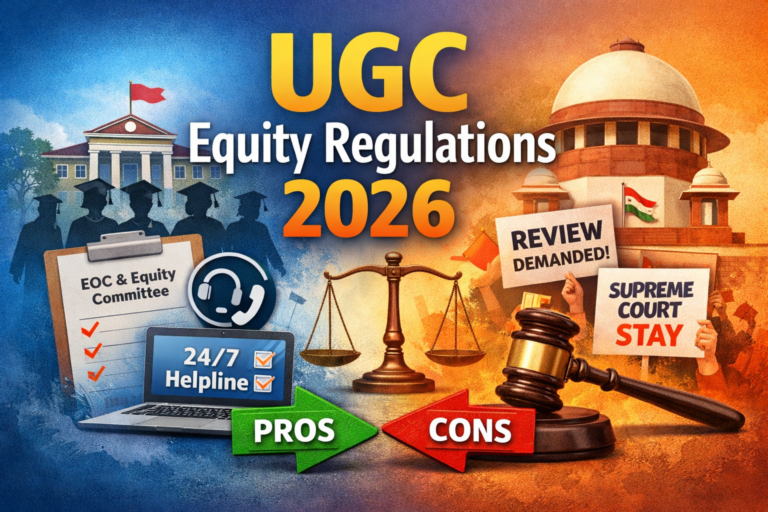
In January 2026, the University Grants Commission (UGC) notified a major set of rules aimed at reducing discrimination and improving inclusion across universities and colleges: The University Grants Commission (Promotion of Equity in Higher Education Institutions) Regulations, 2026.
The regulations quickly became controversial and were followed by protests and political debate. On January 29, 2026, the Supreme Court kept these regulations in abeyance (stayed them), citing concerns such as vagueness and potential misuse, and asked for a more careful review.
This article explains what the new rules tried to change, their likely benefits and risks, and how different groups—including some “general category/upper caste” organisations—have reacted.
Table of Contents
What exactly did UGC change in 2026?
1) Wider and clearer scope of “discrimination”
The regulations define discrimination broadly as unfair or biased treatment (explicit or implicit) on grounds like religion, race, caste, gender, place of birth, disability, etc., and explicitly mention protection for groups including SC, ST, socially and educationally backward classes (OBC), EWS, and persons with disabilities.
2) Mandatory campus structures: Equal Opportunity Centre + Equity Committee
Every Higher Education Institution (HEI) must establish an Equal Opportunity Centre (EOC) and an Equity Committee to manage the centre and inquire into complaints. The Equity Committee’s composition includes the head of the institution (chair), senior faculty, a staff member, and civil society representatives.
3) Reporting & accessibility tools: Online portal, Equity Helpline, Equity Ambassadors
The regulations propose:
- an online portal for reporting incidents,
- a 24×7 Equity Helpline, with confidentiality if requested,
- “Equity Ambassadors” in departments/hostels/libraries, etc.
4) Reporting requirements and strong enforcement provisions
HEIs are expected to publish periodic reports (including demographic composition and complaint status). For non-compliance, the UGC framework includes serious consequences such as being barred from UGC schemes, degree programmes, ODL/online programmes, and even removal from certain lists under the UGC Act.
2026 vs 2012: what looks different?
Here’s a simple comparison (high-level) between the older framework and the 2026 approach discussed in explainers and the official notification.
| Area | Earlier approach (2012 framework) | 2026 approach (new rules) |
| Campus structure | Equity intent existed, but implementation varied widely | Mandatory EOC + Equity Committee, plus local “Equity Ambassadors/Squads” |
| Access to complaints | Often unclear where/how to complain | Online portal + 24×7 helpline with confidentiality option |
| Oversight | Less visible monitoring | UGC monitoring mechanism + reporting expectations |
| Enforcement | Weaker/less explicit deterrence | Strong penalties for non-compliance (schemes/programmes restrictions) |
| Public debate | Lower national visibility | Major protests + Supreme Court stay |
For deeper “what changed and why it matters”, multiple explainers compared the 2012 and 2026 frameworks.
Positive aspects (why supporters say it matters)
1) Faster, clearer support for students facing discrimination
A helpline, portal, and designated campus contacts can reduce the “run-around” students often face when trying to report harassment or discrimination—especially in hostels and departments where power dynamics are strong.
2) Institutions are pushed to take accountability
By making the head of the institution responsible for compliance and setting reporting expectations, the rules attempt to prevent the common pattern of “committee exists only on paper.”
3) Helps standardise equity protections across India
Because the rules apply across HEIs, supporters argue they can create a baseline of protections—especially important for students moving from smaller towns to large universities.
Negative aspects (what critics worry about)
1) “Vague” definitions can create fear of misuse or overreach
The Supreme Court’s stay indicates that the Court found problems serious enough to pause the rules and seek review—one key concern highlighted in coverage is that the language was viewed as unclear/vague and capable of misuse.
2) Due-process concerns: how investigations are triggered and handled
Critics worry about how complaints will be assessed, what safeguards exist against false complaints, and whether faculty/students get fair hearing processes—especially in sensitive cases where reputations and careers are affected. (This is part of the broader debate reported around protests and reactions.)
3) Administrative burden for colleges with limited staff
Smaller colleges may find it difficult to run 24×7 helplines, keep detailed reporting, and maintain committees—without turning it into a box-ticking exercise.
4) Risk of politicisation on campuses
Once protests, party statements, and student groups enter the picture, implementation can become less about student protection and more about political messaging—something visible in the way the issue quickly escalated nationally.
“View of upper caste / general category”: what has been said (without stereotyping)
It’s important to say clearly: there is no single “upper caste view.” People from traditionally advantaged castes/general category students hold a range of opinions—from strong support for anti-discrimination measures to strong opposition to how these rules were drafted.
That said, some upper-caste/community organisations and many general-category student voices highlighted these concerns (as reported):
Common concerns raised by some groups
- University autonomy: claims that the rules interfere too much in internal functioning.
- Fear of “reverse discrimination” or social division: argument that the regulations could deepen caste tensions instead of reducing them.
- Misuse / unclear wording: demand for clearer definitions and safeguards; some welcomed the Supreme Court stay as a chance to revise “vague” provisions.
What we also see on the ground
Reports show mixed student reactions—including general category groups celebrating the stay, while many OBC/SC/ST students called it a setback for protections and asked for reforms without dilution.
A balanced takeaway is this: the demand for safety + the demand for due process can both be valid—and the policy challenge is designing a system that protects vulnerable students while preventing unfair targeting or procedural abuse.
Why did the Supreme Court stay the regulations?
Coverage across legal and mainstream outlets reports that the Supreme Court paused (stayed) the 2026 regulations, pointing to concerns like vagueness and the possibility of misuse, and indicated the need for review/redrafting.
So, at the moment, the long-term shape of these rules depends on what changes are proposed next and what the Court finally upholds.
What could be the best “middle path”?
If policymakers want the idea to succeed, many observers suggest reforms like:
- Tighter definitions and clear examples of what qualifies as discrimination/harassment,
- Time-bound procedures with written reasons at each stage,
- Penalties for malicious complaints (carefully designed so genuine complainants aren’t scared),
- Independent review/appeal safeguards,
- Capacity support for smaller colleges to implement helplines and reporting properly.
This approach keeps the goal (equity and safety) while reducing fear of arbitrariness.
FAQs
Q1. What is the UGC Equity Regulation 2026 about?
It is a UGC regulation notified in January 2026 to promote equity and reduce discrimination in HEIs through structures like Equal Opportunity Centres, Equity Committees, helplines, and reporting mechanisms.
Q2. Is it currently implemented?
The Supreme Court has kept the regulations in abeyance (stayed them) as of January 29, 2026, pending review.
Q3. Why are people protesting?
Protests include concerns about vague drafting, potential misuse, campus autonomy, and social division, while supporters argue the rules are needed to stop discrimination and ensure accountability.
Q4. Does the regulation only cover caste discrimination?
The text addresses discrimination on several grounds (religion, race, caste, gender, place of birth, disability, etc.) and also defines caste-based discrimination specifically for SC/ST/OBC.