
India is witnessing two extreme weather events at the same time — an intensifying heatwave across northern and central regions and the gradual advance of the Southwest Monsoon 2026 over southern and eastern seas. According to the latest bulletin issued by the India Meteorological Department on 23 May 2026, the monsoon has advanced further into parts of the Arabian Sea, Bay of Bengal, and Andaman Sea, while severe heatwave conditions are expected to continue across many states for the next several days.
The latest weather maps released by IMD show the expected progress of the monsoon across India and indicate possible onset dates for different states during June and early July. At the same time, the weather agency has issued red and orange alerts for heatwave conditions in several regions including Uttar Pradesh, Rajasthan, Madhya Pradesh, Vidarbha, and Delhi-NCR.
Southwest Monsoon 2026 Has Advanced Further
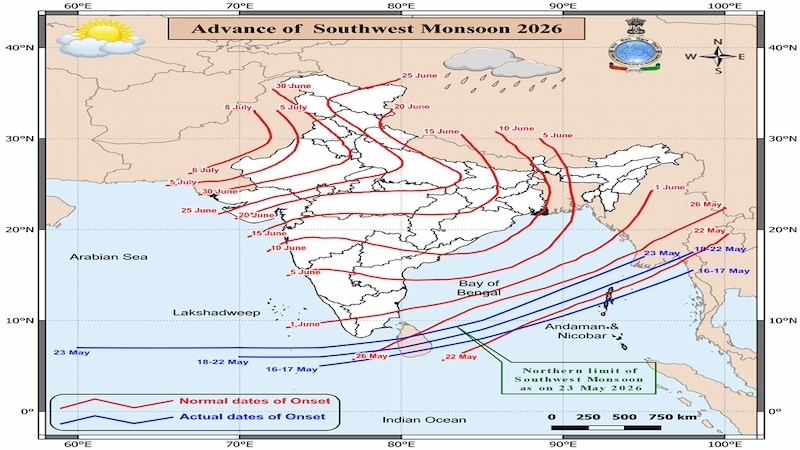
The IMD stated that the Southwest Monsoon has further advanced into some more parts of the southwest Arabian Sea, southeast Arabian Sea, Comorin area, east-central Bay of Bengal, and most parts of the Andaman Sea as of 23 May 2026.
According to the monsoon progression map shown in Annexure I of the IMD bulletin, the Northern Limit of Monsoon currently passes through:
- 7°N/60°E
- 7°N/70°E
- 7°N/75°E
- 8°N/80°E
- 10°N/85°E
- 13.5°N/90°E
- 17°N/95°E
The weather department has also said that conditions remain favorable for further monsoon advancement during the next three to four days.
The monsoon advance chart released by IMD visually explains how the southwest monsoon is likely to progress across the country between late May and July. The map on page 5 of the bulletin highlights the normal and actual onset dates of monsoon across different regions of India.
Monsoon May Reach Kerala Soon
Traditionally, the Southwest Monsoon enters Kerala around 1 June. However, the latest IMD observations suggest that monsoon activity over the Arabian Sea and Bay of Bengal is strengthening steadily.
Rainfall activity has already intensified over Kerala, Lakshadweep, Tamil Nadu, and parts of Karnataka. IMD has forecast widespread light to moderate rainfall along with thunderstorms and gusty winds over Kerala and Lakshadweep between 23 and 27 May.
This indicates that the official onset over Kerala may occur close to its normal schedule if favorable atmospheric conditions continue.
Severe Heatwave Continues Across North and Central India
While monsoon clouds are advancing in southern seas, large parts of northern and central India are battling extremely high temperatures.
According to the IMD bulletin, heatwave to severe heatwave conditions are likely to continue over:
- Uttar Pradesh
- Madhya Pradesh
- Vidarbha
- Rajasthan
- Haryana
- Delhi
- Telangana
- Bihar
- Odisha
- Chhattisgarh
for the next several days.
The weather department warned that severe heatwave conditions are highly likely over East Uttar Pradesh, East Madhya Pradesh, Vidarbha, and West Rajasthan between 24 and 29 May.
Temperatures Crossed 47°C in India
The IMD reported that maximum temperatures were recorded between 45°C and 47°C across many parts of central India and adjoining regions on 22 May 2026. The highest temperature in the country was recorded at Brahmapuri in Vidarbha at 47.2°C.
Several states are currently experiencing temperatures significantly above normal levels. The bulletin noted temperature departures of 5°C to 7°C above normal in some regions.
Delhi-NCR Weather Forecast
Delhi-NCR is expected to continue facing intense heat conditions during the coming days. IMD has forecast:
- Maximum temperatures between 43°C and 45°C
- Strong surface winds
- Dust storms and isolated thunderstorms
- Heatwave conditions at isolated places
between 23 and 26 May.
The weather agency also warned of strong wind speeds reaching up to 60 kmph during thunderstorms.
Heavy Rainfall Alert Issued for Several States
Even as northern India reels under heatwave conditions, heavy rainfall warnings have been issued for multiple northeastern and southern states.
According to IMD forecasts, heavy to very heavy rainfall is likely over:
- Arunachal Pradesh
- Assam and Meghalaya
- Nagaland, Manipur, Mizoram and Tripura
- Kerala
- Lakshadweep
- Tamil Nadu
- Sub-Himalayan West Bengal and Sikkim
during the next four to five days.
The bulletin also warns of localized flooding, waterlogging, traffic disruption, and landslides in vulnerable regions.
Fishermen Warning Issued
The IMD has advised fishermen not to venture into several parts of the Arabian Sea and Bay of Bengal due to rough weather and strong winds.
Warnings have been issued for:
- Gulf of Mannar
- South Bay of Bengal
- Kerala coast
- Karnataka coast
- Lakshadweep region
- Andaman Sea
- Southwest Arabian Sea
between 23 and 27 May.
IMD’s Weather Warning Maps Explained
The weather warning maps released in Annexure III classify different regions using yellow, orange, and red alerts depending on the severity of expected weather conditions. The maps for Day 1 to Day 7 show:
- Red alert zones for severe heatwave areas
- Orange alerts for heavy rain and thunderstorms
- Yellow alerts for moderate weather warnings
The bulletin specifically advises authorities to take action based on orange and red alerts, especially in vulnerable urban and hilly areas.
Health Risks During Heatwave
The IMD has warned that severe heatwave conditions can pose a serious health risk, especially for:
- Elderly people
- Children
- Outdoor workers
- Individuals with chronic illnesses
The agency advised people to:
- Avoid direct sunlight
- Drink sufficient water
- Wear lightweight cotton clothes
- Use ORS, lemon water, buttermilk, and other fluids to stay hydrated.
Also Read: What is El Niño and La Nina? How It Impacts India’s Monsoon and Weather Patterns
Impact on Agriculture
The weather bulletin also contains detailed agrometeorological advisories for farmers. The IMD has suggested irrigation management, drainage preparation, mulching, and crop protection measures for different states affected by heatwaves or heavy rainfall.
Farmers in states facing heavy rainfall have been advised to maintain proper drainage systems, while those in heatwave-hit areas have been advised to ensure regular irrigation and moisture conservation practices.
What the Monsoon Map Reveals
The monsoon onset map released by IMD provides a broad estimate of when different regions may receive monsoon rains.
Expected Monsoon Progress:
| Region | Expected Onset |
|---|---|
| Kerala | Around 1 June |
| Mumbai | Around 10 June |
| Central India | Mid-June |
| Delhi | Late June to Early July |
| Rajasthan | Early July |
The chart also compares actual and normal monsoon onset timelines across India.
India is currently witnessing a dramatic weather transition phase. While the Southwest Monsoon 2026 is steadily advancing over southern seas and northeastern regions, large parts of northern and central India remain under the grip of intense heatwave conditions.
The coming weeks will be crucial for agriculture, water resources, and overall weather conditions across the country. Citizens are advised to closely follow official weather updates issued by the India Meteorological Department and take necessary precautions against both extreme heat and heavy rainfall events.
The latest IMD bulletin and monsoon advance maps indicate that the 2026 monsoon season has officially begun progressing toward mainland India, bringing hope for relief from the scorching summer heat.
Also Read: Cyclone Explained: What It Is, Types, How It Forms & Why It’s So Dangerous
Frequently Asked Questions (FAQs)
-
When will the Southwest Monsoon 2026 reach Kerala?
According to the latest India Meteorological Department update, the Southwest Monsoon has already advanced into parts of the Arabian Sea and Bay of Bengal. If current conditions remain favorable, monsoon onset over Kerala is expected around its normal schedule near 1 June 2026.
-
Which states are under severe heatwave alert in May 2026?
IMD has issued severe heatwave warnings for several states including Uttar Pradesh, Rajasthan, Madhya Pradesh, Vidarbha, Haryana, Delhi, Telangana, Bihar, Odisha, and Chhattisgarh. Some areas may continue experiencing temperatures above 45°C.
-
What is the Northern Limit of Monsoon (NLM)?
The Northern Limit of Monsoon refers to the imaginary line showing how far the southwest monsoon has progressed over India and nearby seas. IMD regularly updates this line to track monsoon advancement across the country.
-
Why is India facing heatwaves even as the monsoon advances?
India often experiences overlapping weather systems during late May and early June. While monsoon currents begin strengthening over southern and eastern regions, northern and central India can still remain under intense dry heat conditions until monsoon winds fully advance inland.
-
Which regions are likely to receive heavy rainfall in the coming days?
According to IMD forecasts, heavy to very heavy rainfall is likely over Kerala, Lakshadweep, Assam, Meghalaya, Arunachal Pradesh, Sub-Himalayan West Bengal, Sikkim, Tamil Nadu, and several northeastern states during the next few days.
-
What precautions should people take during severe heatwave conditions?
People should avoid direct sun exposure, stay hydrated, wear lightweight cotton clothes, use umbrellas or caps outdoors, and avoid strenuous activities during peak afternoon hours. Vulnerable groups such as children and elderly individuals should remain extra cautious.
-
How accurate are IMD’s long-range monsoon forecasts?
IMD forecasts are based on advanced meteorological models and satellite observations. However, the department itself notes that forecast accuracy decreases as the lead period increases, especially for rainfall intensity and localized weather events.
-
What do Yellow, Orange, and Red weather alerts mean?
Yellow Alert: Be aware and stay updated
Orange Alert: Be prepared and take precautionary measures
Red Alert: Take action immediately due to severe weather risk
These alerts help authorities and citizens prepare for dangerous weather situations. -
Can the 2026 monsoon reduce ongoing heatwave conditions quickly?
Yes, monsoon rainfall usually brings significant relief from extreme summer temperatures. However, until the monsoon fully advances into northern and central India, heatwave conditions may continue in many regions.
For more latest updates on Trending News, Entertainment, Automobile, Education, Technology, Jobs, weather and sports visit IndicDaily.